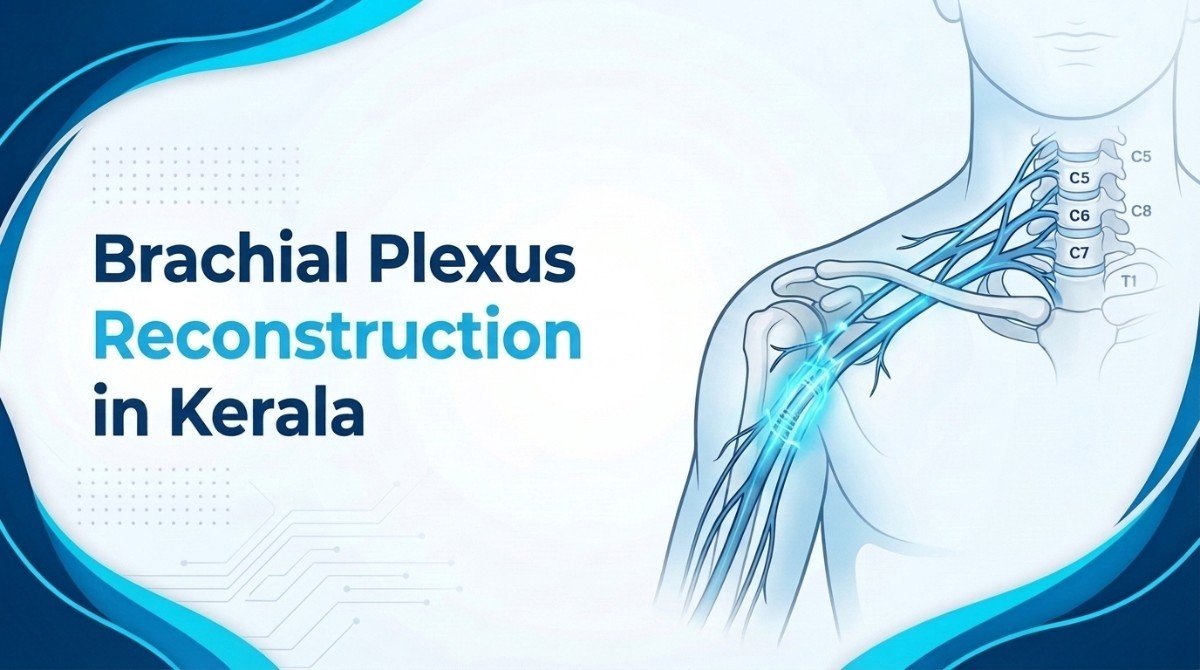
Brachial Plexus Reconstruction in Kerala: 7 Essential Facts About Recovery
Brachial Plexus Reconstruction in Kerala involves specialised treatment planning for nerve injuries that affect movement, strength and sensation in the shoulder, arm and hand. The brachial plexus is a network of nerves extending from the spinal cord through the neck and shoulder into the upper limb. When these nerves are severely damaged, a person may experience weakness, loss of movement, numbness or difficulty performing everyday activities.
Reconstruction may be considered when the damaged nerves are unlikely to recover sufficiently without intervention. The treatment plan aims to restore useful nerve function where possible, improve selected movements and address functional limitations caused by the injury.
Not every patient requires reconstructive surgery. Some injuries may improve with observation and rehabilitation, while others need early surgical assessment. The appropriate approach depends on the injury pattern, the time since the injury, the condition of the affected muscles and the patient’s functional needs.
What Is Brachial Plexus Reconstruction?
Brachial plexus reconstruction refers to a group of surgical and rehabilitative approaches intended to improve function after significant damage to the brachial plexus nerves.
The brachial plexus carries signals that control several important upper-limb functions, including:
Shoulder movement and stability
Bending and straightening the elbow
Forearm rotation
Wrist movement
Finger movement and grip
Sensation across different areas of the arm and hand
When the nerve pathways are damaged, these functions may become partially or completely affected. Reconstruction is planned according to the specific nerves involved and the movements that have been lost.
The overall aim is not necessarily to restore every function to its previous level. Instead, treatment planning focuses on improving meaningful activities, such as bringing the hand towards the face, positioning the arm, holding objects or performing selected daily tasks.
When Is Brachial Plexus Reconstruction Considered?
Reconstruction may be considered when the injury causes significant functional loss and the affected nerves are unlikely to recover adequately without treatment.
The decision requires an assessment of the injury and its recovery potential. Some patients may initially be monitored because stretched nerves can sometimes recover without surgery. However, severe nerve disruptions may require early reconstructive evaluation.
Common situations in which reconstruction may be considered include:
Severe Nerve Damage
A complete nerve rupture or significant disruption of the brachial plexus may prevent normal nerve signals from reaching the affected muscles. Reconstruction may be evaluated to provide an alternative pathway for nerve regeneration or restore selected functions.
Nerve Root Avulsion
Nerve root avulsion occurs when a nerve root is pulled away from its attachment to the spinal cord. This is a serious injury because the original nerve connection is disrupted. Depending on the injury pattern, reconstructive options may involve using functioning nerves from other pathways.
Persistent Loss of Muscle Function
Some patients continue to experience significant weakness or paralysis despite an appropriate period of observation and rehabilitation. If clinical assessments indicate inadequate recovery, reconstructive treatment may be considered.
Longstanding Functional Limitations
Patients who present after a prolonged period may still have options to improve selected movements. However, the available approaches may differ because prolonged loss of nerve supply can affect muscle condition and the potential for nerve-based recovery.
Failure to Regain Useful Movement
When an injury does not recover sufficiently to support important daily activities, a specialist may evaluate whether reconstruction could improve the remaining functional capacity.
The decision is individualised. The presence of weakness alone does not automatically mean that surgery is required.
Main Goals of Brachial Plexus Reconstruction
Reconstruction is planned around the functions most important to the patient. Since brachial plexus injuries vary considerably, the goals may differ from one person to another.
Restoring Shoulder Function
Shoulder control is important for positioning the arm and reaching objects. Weakness in the shoulder may make it difficult to lift or rotate the arm.
Reconstructive planning may consider ways to improve shoulder stability, movement and positioning. The specific goal depends on the nerves affected and the muscles that remain functional.
Improving Elbow Flexion
Elbow flexion allows a person to bring the hand towards the face and perform several everyday tasks. Restoring this movement is often an important functional priority in selected severe brachial plexus injuries.
The reconstructive plan considers whether the muscles responsible for elbow movement can receive useful nerve signals or whether another functional approach may be needed.
Supporting Hand and Wrist Function
Hand and wrist function is essential for gripping, holding, releasing and manipulating objects. However, restoring fine hand movement can be particularly challenging in extensive brachial plexus injuries.
The treatment plan may consider the available nerve pathways, muscle condition, sensation and remaining movement when determining realistic goals.
Improving Sensation
Sensory function helps a person recognise touch, pressure and potentially harmful stimuli. Depending on the injury pattern, sensory restoration may also be considered as part of the overall reconstructive plan.
Improving sensation and movement are separate but related treatment goals. The potential for each should be discussed individually.
Types of Reconstructive Approaches
Brachial plexus reconstruction is not limited to one surgical technique. Different approaches may be selected or combined depending on the injury and the functions that need attention.
Primary Nerve Reconstruction
Primary reconstruction refers to procedures directed at restoring the damaged nerve pathways. Depending on the injury, this may involve nerve repair, nerve grafting or nerve transfer.
The aim is to establish a route through which nerve signals can reach the affected muscles. The selection depends on the location and extent of the injury and the availability of healthy nerve structures.
Secondary Functional Reconstruction
When primary nerve reconstruction is not suitable or does not provide sufficient functional improvement, additional reconstructive options may be considered.
These approaches may include tendon transfers, muscle transfers, joint procedures or other methods designed to improve selected movements.
Secondary reconstruction may be especially relevant in longstanding injuries where the affected muscles have experienced prolonged loss of nerve supply.
Combined Reconstruction
Some complex injuries require more than one reconstructive approach. A treatment plan may combine nerve reconstruction with procedures intended to improve joint position, muscle balance or movement.
The decision depends on the patient’s functional limitations and the structures that remain available for reconstruction.
The choice of approach should be based on a comprehensive assessment rather than the assumption that one procedure is suitable for every injury.
How Is a Reconstruction Plan Developed?
Planning brachial plexus reconstruction involves understanding the complete injury pattern and identifying which functions may be improved.
Several factors influence the treatment decision.
1. Location and Extent of Nerve Damage
The brachial plexus contains several nerve roots and branches. An injury may affect a single part of the network or multiple levels.
The location helps determine which muscles and movements are affected and which reconstructive options may be available.
2. Type of Injury
A stretched nerve, a ruptured nerve and an avulsed nerve root have different recovery characteristics. The reconstructive plan must account for whether the original nerve pathway remains usable.
3. Time Since Injury
The time elapsed since the injury is an important factor in planning treatment. Prolonged denervation can lead to changes in the affected muscles and may reduce the potential for successful nerve-based reconstruction.
4. Condition of the Target Muscles
The condition of the muscles that have lost their nerve supply helps determine whether nerve reconstruction is likely to be useful.
If the target muscles have undergone significant irreversible changes, alternative functional reconstruction may need to be considered.
5. Available Functional Nerves and Muscles
Some reconstructive approaches require suitable functioning donor nerves or muscles. The specialist evaluates what structures remain available and whether using them could affect other important functions.
6. Patient’s Functional Requirements
Treatment goals should reflect the patient’s daily activities, work requirements, independence and personal priorities.
For one patient, improving elbow movement may be the main goal. Another may place greater importance on shoulder positioning, hand use or pain management.
Why Is Early Evaluation Important?
The timing of assessment can influence reconstructive planning. Some brachial plexus injuries require urgent attention, while others may be observed to determine whether spontaneous recovery occurs.
For certain closed traction injuries, specialists may monitor neurological improvement through repeated clinical examinations and investigations. If recovery is inadequate, reconstructive surgery may be considered within a suitable time window.
Open nerve injuries, suspected root avulsions and injuries involving associated vascular damage may require earlier specialist assessment.
There is no universal timeline for every injury. The appropriate timing depends on the mechanism of injury, the structures affected and the clinical findings.
Delayed referral can make some nerve reconstruction options less suitable because the muscles may lose their ability to respond to restored nerve signals. Therefore, patients with significant weakness or loss of arm movement after trauma should seek timely medical evaluation.
Role of Rehabilitation in Brachial Plexus Reconstruction
Rehabilitation is an essential part of the overall treatment process. Surgical reconstruction alone does not guarantee the return of useful movement. The affected muscles and joints may need continued care while nerve recovery progresses.
A rehabilitation programme is planned according to the injury, the procedure performed and the patient’s functional condition.
Maintaining Joint Mobility
When muscles are weak or paralysed, the joints may become stiff due to reduced movement. Appropriate exercises may help maintain flexibility and reduce the risk of contractures.
Supporting Muscle Function
Physiotherapy may help maintain the strength of unaffected muscles and support the gradual development of movement as nerve function improves.
Improving Everyday Activities
Occupational therapy may help patients practise functional tasks and learn ways to manage daily activities while recovery is ongoing.
Protecting the Affected Limb
Patients may require guidance on positioning and protecting the affected arm, especially when sensation is reduced. This can help reduce the risk of unnoticed injuries.
Monitoring Functional Progress
Regular follow-up allows the treating team to assess movement, strength, joint flexibility and other functional changes. The rehabilitation plan may be adjusted as recovery progresses.
The timing and intensity of exercises must follow the treating surgeon’s instructions. Rehabilitation should not place unnecessary stress on healing surgical structures.
What Factors Influence Functional Recovery?
Recovery after brachial plexus reconstruction varies considerably. Several factors may influence the extent and pace of improvement.
Severity of injury: Extensive nerve damage may be more difficult to reconstruct than a limited injury.
Location of damage: The distance between the reconstruction site and the target muscles can influence the time needed for nerve regeneration.
Timing of treatment: Earlier assessment may help preserve suitable reconstructive options.
Muscle condition: The health of the affected muscles is important for functional recovery.
Type of reconstruction: Different approaches have different healing and rehabilitation requirements.
Age and general health: Individual health factors may influence healing and participation in rehabilitation.
Consistency of rehabilitation: Following the prescribed therapy programme is important for maintaining joint mobility and practising recovered functions.
Even with appropriate treatment, complete restoration of normal movement may not be possible. The expected benefits and limitations should be discussed before proceeding.
Possible Limitations and Complications
Brachial plexus reconstruction is complex, and the outcome cannot be guaranteed. Potential complications depend on the procedures performed and the patient’s individual health condition.
Possible concerns include:
Wound infection or delayed healing
Bleeding or fluid collection
Persistent pain or altered sensation
Scar formation
Donor-site weakness or sensory changes
Limited improvement in movement
Joint stiffness or muscle imbalance
Need for additional reconstructive procedures
Some patients may continue to experience functional limitations even after treatment. A clear discussion of the potential benefits, risks, alternatives and rehabilitation requirements is an important part of treatment planning.
What Should Patients Discuss During a Reconstruction Consultation?
A consultation with a specialist can help patients understand the available options and the functional goals that may be realistic for their injury.
Patients may find it useful to discuss:
Which parts of the brachial plexus are affected?
Is spontaneous nerve recovery still possible?
What reconstructive options may be suitable?
Which arm movements are realistic treatment priorities?
Is primary nerve reconstruction appropriate?
Could secondary reconstruction be required?
What is the expected rehabilitation period?
What limitations may remain after treatment?
Previous medical records, imaging reports, nerve conduction studies and EMG results can help the specialist understand the injury and its progression.
Brachial Plexus Reconstruction in Kerala: Individualised Treatment Planning
Brachial plexus injuries can affect several important functions of the upper limb, making reconstruction a complex process that requires careful assessment and planning. The treatment approach depends on the location and severity of nerve damage, the time since injury, muscle condition and the patient’s functional priorities.
Brachial Plexus Reconstruction in Kerala may involve primary nerve reconstruction, secondary functional procedures or a combination of approaches, depending on individual clinical findings. Rehabilitation remains an important part of the process, helping patients maintain joint mobility and work towards meaningful functional improvement.
Patients experiencing persistent arm weakness, loss of movement or significant functional limitations following an injury should seek specialist assessment. An individualised treatment plan can help determine whether reconstruction is appropriate and what outcomes may realistically be pursued.
- Brachial Plexus Surgery in Kerala
- What Is Nerve Repair Surgery?
- What Is Nerve Graft Surgery?
- Nerve Repair vs Nerve Graft
- When Is Nerve Grafting Needed?
- Recovery After Nerve Graft Surgery
- Can a Damaged Nerve Be Repaired?
- How Long Does Nerve Repair Take to Heal?
- Brachial Plexus Injury Specialist in Kerala
- Brachial Plexus Surgery Specialist in Kerala
- Brachial Plexus Reconstruction in Kerala
Dr. Pradeep Kumar
Plastic & Reconstructive Surgeon – Brachial Plexus & Nerve Surgery Specialist
Dr. Pradeep Kumar is an experienced plastic and reconstructive surgeon known for his expertise in brachial plexus and peripheral nerve surgery. With extensive microsurgical experience, he focuses on restoring movement and function for patients with complex nerve injuries.
Sushrutha Institute of Plastic Surgery, Elite Mission Hospital, Thrissur
Frequently Asked Questions
Brachial plexus reconstruction refers to surgical and rehabilitative approaches used to improve function after significant damage to the nerves supplying the shoulder, arm and hand. Treatment may involve primary nerve reconstruction, secondary functional procedures or a combination of approaches.
Reconstruction may be considered when severe nerve damage causes persistent functional loss and adequate spontaneous recovery is unlikely. The decision depends on the injury pattern, time since injury, muscle condition and potential for functional improvement.
The goals may include improving shoulder stability, elbow movement, wrist and hand function, and sensation. Treatment priorities are selected according to the nerves affected and the activities that are most important to the patient.
Primary reconstruction focuses on restoring damaged nerve pathways through suitable nerve procedures. Secondary reconstruction may involve approaches such as tendon transfer, muscle transfer or selected joint procedures to improve function when nerve reconstruction alone is unsuitable or insufficient.
Some patients may experience improvements in selected movements after reconstruction and rehabilitation. However, the extent of recovery depends on the severity of nerve damage, timing of treatment, muscle condition and individual healing. Complete restoration of normal function cannot be guaranteed.
Rehabilitation helps maintain joint mobility, manage stiffness and support functional improvement. Physiotherapy and occupational therapy may be included to help patients practise movements and everyday activities according to their recovery progress and surgical instructions.
Recovery may be influenced by the severity and location of the injury, time since injury, condition of the affected muscles, type of reconstruction, general health and participation in the recommended rehabilitation programme.
Some patients with longstanding injuries may still have options to improve selected functions. The suitability of reconstruction depends on the condition of the muscles and joints, available functional nerves and the time elapsed since injury. A specialist assessment is needed to determine appropriate options.