Nerve Repair vs Nerve Graft: 7 Key Differences Explained
Nerve Repair vs Nerve Graft is an important comparison when understanding the surgical options available for certain peripheral nerve injuries. Both procedures aim to restore continuity in a damaged nerve and support the regeneration of nerve fibres. However, they differ in how the damaged nerve is reconstructed and when each technique may be appropriate.
Peripheral nerves carry signals between the brain, spinal cord, muscles, and sensory areas throughout the body. Injuries caused by accidents, cuts, fractures, stretching, or other trauma can interrupt these signals and lead to weakness, numbness, tingling, pain, or loss of movement. Depending on the severity and extent of the damage, surgical treatment may involve direct nerve repair or nerve grafting.
Understanding the differences between these procedures can help patients learn why a surgeon may recommend one approach over another. The choice depends on factors such as the condition of the nerve ends, the presence of a nerve gap, the location of the injury, and the patient’s clinical findings.
What Is Nerve Repair Surgery?
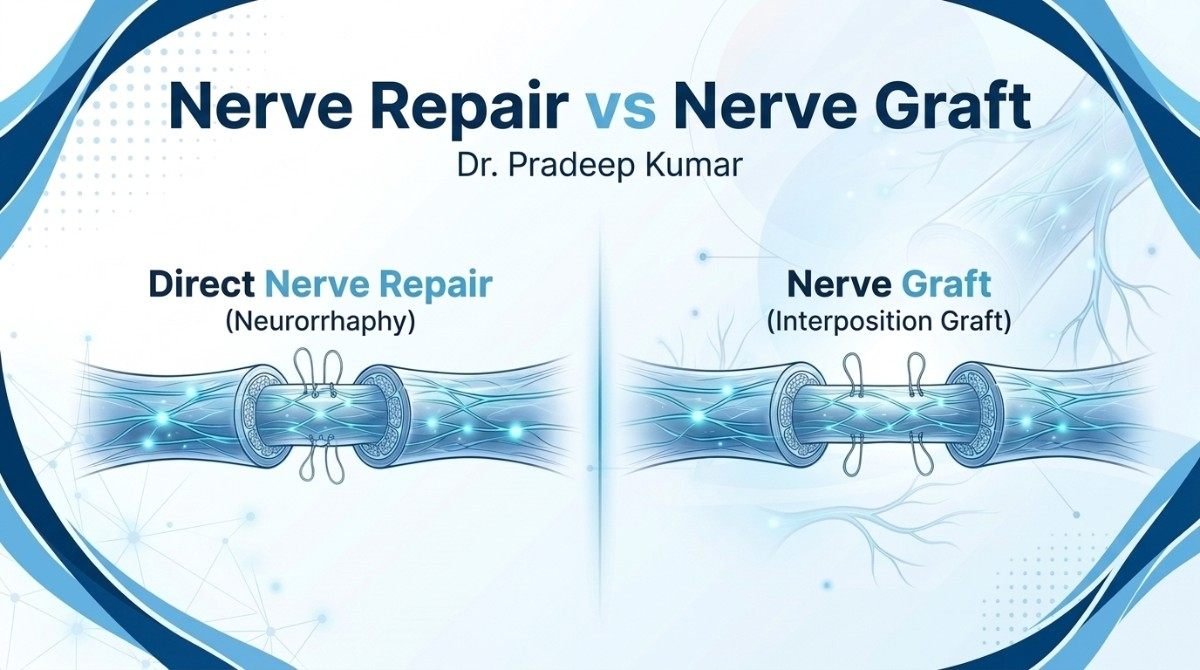
Nerve repair surgery is a procedure performed to reconnect damaged portions of a nerve and restore its structural continuity. It may be considered when a nerve has been cut or injured but the healthy nerve ends can be brought together without excessive tension.
In direct nerve repair, the surgeon carefully identifies the damaged nerve ends and uses specialised microsurgical techniques to align and reconnect them. Fine sutures may be placed around the nerve’s outer covering to maintain proper alignment while the healing process begins.
The purpose of direct nerve repair is to create a suitable pathway for regenerating nerve fibres to grow across the injured area. The potential for functional recovery depends on the injury’s severity, the time before treatment, and the condition of the affected nerve and surrounding tissues.
What Is Nerve Graft Surgery?
Nerve graft surgery is a reconstructive procedure used when a damaged nerve has a gap that cannot be closed through direct repair without excessive tension. Instead of pulling the nerve ends together, the surgeon uses a suitable graft segment to bridge the missing portion.
The graft acts as a pathway through which regenerating nerve fibres may grow from the healthy proximal nerve segment towards the distal portion. Depending on the clinical situation, the graft may be obtained from another nerve in the patient’s body or selected from other suitable graft materials.
Nerve grafting may be considered for certain severe nerve injuries, including injuries involving significant tissue loss or extensive damage to a nerve. The suitability of the procedure depends on the location and length of the gap, the condition of the nerve ends, and the patient’s overall clinical assessment.
Nerve Repair vs Nerve Graft: What Are the Main Differences?
Although both procedures aim to restore nerve continuity, they are used in different clinical situations.
1. Surgical Technique
The main difference between nerve repair and nerve grafting is the method used to reconnect the damaged nerve.
In direct nerve repair, the surgeon brings the healthy nerve ends together and reconnects them using microsurgical techniques. No additional nerve segment is required when the ends can be joined without excessive tension.
In nerve graft surgery, a separate graft segment is placed between the damaged nerve ends. This is necessary when a gap prevents direct reconnection.
2. Presence of a Nerve Gap
The presence of a gap between the healthy nerve ends is an important factor when choosing the surgical technique.
Direct nerve repair may be suitable when the gap is absent or small enough for the nerve ends to be joined safely without tension after appropriate preparation.
Nerve grafting may be required when a section of the nerve is missing or the gap is too large for direct reconnection. The surgeon evaluates the gap and surrounding tissue before deciding which method is appropriate.
3. Use of Additional Graft Tissue
Direct nerve repair uses the patient’s existing nerve ends to restore continuity. It does not normally require a separate graft segment.
Nerve graft surgery involves placing additional tissue between the damaged nerve ends. In some procedures, a healthy sensory nerve from another part of the patient’s body may be used as an autograft. Selected donor nerve grafts or other reconstruction materials may also be considered in appropriate cases.
4. Surgical Complexity
Both procedures require specialised surgical skills and careful handling of nerve tissue.
Direct nerve repair involves precise alignment and reconnection of the damaged nerve ends. Nerve grafting involves additional steps, including selecting and preparing the graft and connecting it to the healthy nerve segments.
The complexity of either procedure depends on the injury location, extent of damage, surrounding tissue condition, and the reconstruction required.
5. Recovery Considerations
Recovery following either procedure depends on the type of nerve injury and the distance regenerating nerve fibres must travel to reach their target muscles or sensory areas.
After direct nerve repair, nerve fibres may gradually regenerate across the repaired area. Following nerve grafting, regeneration must also occur through the graft segment.
Neither procedure guarantees complete recovery. The return of movement and sensation may take several months or longer, depending on the individual injury and treatment circumstances.
Comparison Between Nerve Repair and Nerve Graft
| Feature | Direct Nerve Repair | Nerve Graft Surgery |
|---|---|---|
| Main technique | Reconnects the damaged nerve ends directly | Uses a graft to bridge a nerve gap |
| Nerve gap | Suitable when ends can be joined without excessive tension | Considered when direct reconnection is not possible without tension |
| Graft material | Usually not required | Requires a suitable graft segment or reconstruction material |
| Surgical steps | Alignment and reconnection of nerve ends | Graft preparation and connection to both nerve ends |
| Recovery | Depends on injury severity and nerve regeneration distance | Depends on graft length, injury severity and nerve regeneration |
| Main objective | Restore continuity between the damaged nerve ends | Bridge the missing nerve segment and support regeneration |
The comparison provides a general overview. The actual surgical approach is selected according to the patient’s nerve injury and clinical findings.
When Is Direct Nerve Repair Recommended?
Direct nerve repair may be considered when the damaged nerve ends are identifiable and can be brought together without excessive tension. The surgeon must assess whether the nerve tissue is healthy enough for a suitable repair.
It may be considered in certain injuries involving:
Clean nerve cuts with identifiable and suitable nerve ends.
Nerve injuries where the damaged section can be removed and the remaining ends can be joined without excessive tension.
Selected traumatic injuries where the nerve remains structurally suitable for direct reconstruction.
Injuries where the gap is sufficiently small after appropriate surgical preparation.
The decision is not based only on the visible length of the injury. The surgeon also evaluates the extent of internal nerve damage and the quality of the remaining nerve tissue.
When Is Nerve Grafting Recommended?
Nerve grafting may be considered when direct nerve repair cannot restore continuity without placing excessive tension on the nerve. This can occur when a portion of the nerve is missing or when damaged tissue must be removed, leaving a significant gap.
Situations in which grafting may be considered include:
Significant nerve tissue loss: A section of the nerve is missing following an injury.
Severe traumatic nerve damage: The damaged portion cannot be repaired directly after the unhealthy tissue is addressed.
Large nerve gaps: The healthy nerve ends cannot be brought together safely without excessive tension.
Selected brachial plexus injuries: Certain injuries involving the network of nerves supplying the shoulder, arm, and hand may require nerve graft reconstruction.
Complex nerve injuries: The surgeon identifies a need for an additional graft segment to restore nerve continuity.
Not every severe nerve injury requires grafting. The most appropriate technique depends on the pattern of damage and the available reconstructive options.
Can Nerve Repair or Nerve Grafting Restore Movement and Sensation?
Both procedures aim to support the return of nerve function by restoring a pathway for regenerating nerve fibres. However, the degree of recovery varies from one patient to another.
Nerve fibres generally regenerate gradually. After surgery, the regenerating fibres must travel from the repair or graft site towards the muscles and sensory areas supplied by the injured nerve.
Recovery may be influenced by:
The type and severity of the original nerve injury.
The location of the damaged nerve.
The distance between the surgical repair and the target muscles or sensory areas.
The time between injury and treatment.
The condition of the muscles supplied by the nerve.
The patient’s overall health and rehabilitation progress.
Some patients may experience gradual improvements in sensation, muscle activity, or movement. Others may have incomplete recovery, particularly when the injury is extensive or treatment is delayed.
Physiotherapy, occupational therapy, and appropriate rehabilitation may form part of the recovery plan. The treating team determines the rehabilitation approach according to the patient’s functional needs.
How Do Doctors Decide Between Nerve Repair and Nerve Graft?
Choosing between direct nerve repair and nerve grafting requires a detailed assessment of the injured nerve. The surgeon considers the mechanism of injury, the location of the damage, the condition of the nerve ends, and whether a gap remains after damaged tissue is addressed.
Clinical Examination
The surgeon evaluates muscle strength, movement, sensation, pain, and other symptoms associated with the affected nerve. The examination helps identify which nerve functions may have been affected.
Nerve Conduction Studies and Electromyography
Nerve conduction studies and electromyography (EMG) may be recommended to assess how electrical signals travel through the affected nerves and muscles. These tests can provide information about nerve function and muscle involvement.
Imaging Investigations
Ultrasound, magnetic resonance imaging (MRI), or other imaging investigations may be considered when clinically appropriate. These tests can help assess nerve continuity, surrounding structures, and the extent of certain injuries.
Assessment of the Nerve Gap
During surgical planning, the surgeon evaluates whether the healthy nerve ends can be reconnected directly without excessive tension. If a suitable direct repair is not possible, nerve grafting or another reconstructive technique may be considered.
The final decision is individualised and based on the combined clinical findings rather than a single test result.
Risks and Considerations of Both Procedures
Nerve repair and nerve graft surgery are specialised procedures, and both have potential risks. The risks depend on the injury, the surgical approach, and the patient’s overall health.
Possible considerations include:
Infection or wound-healing problems.
Bleeding or swelling around the surgical area.
Persistent numbness, pain, or altered sensation.
Incomplete recovery of movement or sensation.
Scar tissue formation around the repaired nerve.
Failure to achieve the expected degree of nerve regeneration.
Additional sensory changes at the donor site when an autologous nerve graft is used.
Patients should discuss the possible benefits, limitations, alternatives, and risks with their treating surgeon before making a treatment decision.
Recovery After Nerve Repair and Nerve Graft Surgery
Recovery is a gradual process after both direct nerve repair and nerve grafting. The repaired nerve requires time for regenerating fibres to grow towards the affected muscles and sensory areas.
The recovery timeline varies depending on the injury location, severity, surgical technique, and distance the regenerating fibres must travel.
Patients may be advised to:
Attend scheduled follow-up appointments.
Follow instructions for wound care and activity restrictions.
Participate in prescribed physiotherapy or occupational therapy.
Maintain appropriate joint movement to reduce stiffness.
Follow the rehabilitation plan recommended by the treating team.
Report new or worsening symptoms to their healthcare provider.
Functional improvement may occur gradually, and progress should be assessed over time. Patients should not assume that the absence of immediate movement or sensation after surgery means the procedure has failed.
Nerve Repair vs Nerve Graft: Which Procedure Is Better?
There is no single procedure that is better for every nerve injury. Direct nerve repair may be appropriate when the healthy nerve ends can be reconnected without excessive tension. Nerve grafting may be more suitable when a gap prevents safe direct reconnection.
The decision depends on the nature of the injury, the amount of nerve tissue damaged, the location of the affected nerve, and the patient’s clinical condition.
A specialist assessment helps determine whether direct nerve repair, nerve grafting, nerve transfer, or another reconstructive approach should be considered. The treatment plan should focus on the specific injury and the patient’s functional goals.
Nerve Repair and Nerve Graft Consultation With Dr. Pradeep Kumar in Thrissur
Patients looking for a Brachial Plexus Surgery Doctor , particularly those seeking specialist consultation in Thrissur, can consult Dr. Pradeep Kumar, a Plastic and Reconstructive Surgeon specialising in brachial plexus and peripheral nerve surgery.
Patients with suspected peripheral nerve injuries may require an assessment of muscle strength, sensation, nerve function, injury history, and relevant investigation results. This evaluation helps determine the nature of the nerve damage and whether surgical reconstruction may be appropriate.
The choice between direct nerve repair and nerve grafting depends on the injury pattern and the condition of the damaged nerve. A specialist consultation can help patients understand the available treatment approaches, expected recovery considerations, and the need for further evaluation.
Understanding the Right Approach to Nerve Reconstruction
Nerve repair and nerve grafting are two different surgical approaches used to manage certain peripheral nerve injuries. Direct nerve repair reconnects suitable nerve ends, while nerve grafting uses an additional segment to bridge a gap that cannot be closed safely through direct repair.
Both techniques aim to restore nerve continuity and support regeneration, but their suitability depends on the extent and location of the injury. A detailed clinical assessment is essential to identify the appropriate treatment approach and establish realistic expectations for recovery.
- Brachial Plexus Surgery in Kerala
- What Is Nerve Repair Surgery?
- What Is Nerve Graft Surgery?
- Nerve Repair vs Nerve Graft
- When Is Nerve Grafting Needed?
- Recovery After Nerve Graft Surgery
- Can a Damaged Nerve Be Repaired?
- How Long Does Nerve Repair Take to Heal?
- Brachial Plexus Injury Specialist in Kerala
- Brachial Plexus Surgery Specialist in Kerala
- Brachial Plexus Reconstruction in Kerala

Dr. Pradeep Kumar
Plastic & Reconstructive Surgeon – Brachial Plexus & Nerve Surgery Specialist
Dr. Pradeep Kumar is an experienced plastic and reconstructive surgeon known for his expertise in brachial plexus and peripheral nerve surgery. With extensive microsurgical experience, he focuses on restoring movement and function for patients with complex nerve injuries.
Sushrutha Institute of Plastic Surgery, Elite Mission Hospital, Thrissur
Frequently Asked Questions
Direct nerve repair reconnects the damaged nerve ends when they can be joined without excessive tension. Nerve graft surgery uses an additional nerve segment to bridge a gap when direct reconnection is not suitable.
Nerve grafting may be considered when a section of the nerve is missing or the healthy nerve ends cannot be brought together without excessive tension. The surgeon determines the appropriate technique after evaluating the injury.
Nerve reconstruction is a broader term that includes surgical techniques used to restore nerve continuity or function. Direct nerve repair and nerve grafting are two approaches that may be used as part of nerve reconstruction.
Recovery varies according to the injury, surgical technique, nerve regeneration distance, and individual health factors. Nerve grafting involves regeneration across a graft segment, but recovery cannot be compared using the procedure alone. The surgeon assesses each patient's expected recovery individually.
Both procedures aim to support nerve regeneration, which may help improve muscle function and sensation. The extent of recovery depends on the severity and location of the injury, the time before treatment, and the condition of the affected muscles. Complete recovery is not guaranteed.
Doctors assess the injury location, nerve damage, condition of the nerve ends, and the presence of a gap. Clinical examination, nerve conduction studies, electromyography, and imaging may help guide treatment planning when appropriate.
No. The need for nerve grafting depends on the pattern and extent of the injury. Depending on the clinical findings, direct nerve repair, nerve grafting, nerve transfer, or another reconstructive approach may be considered.