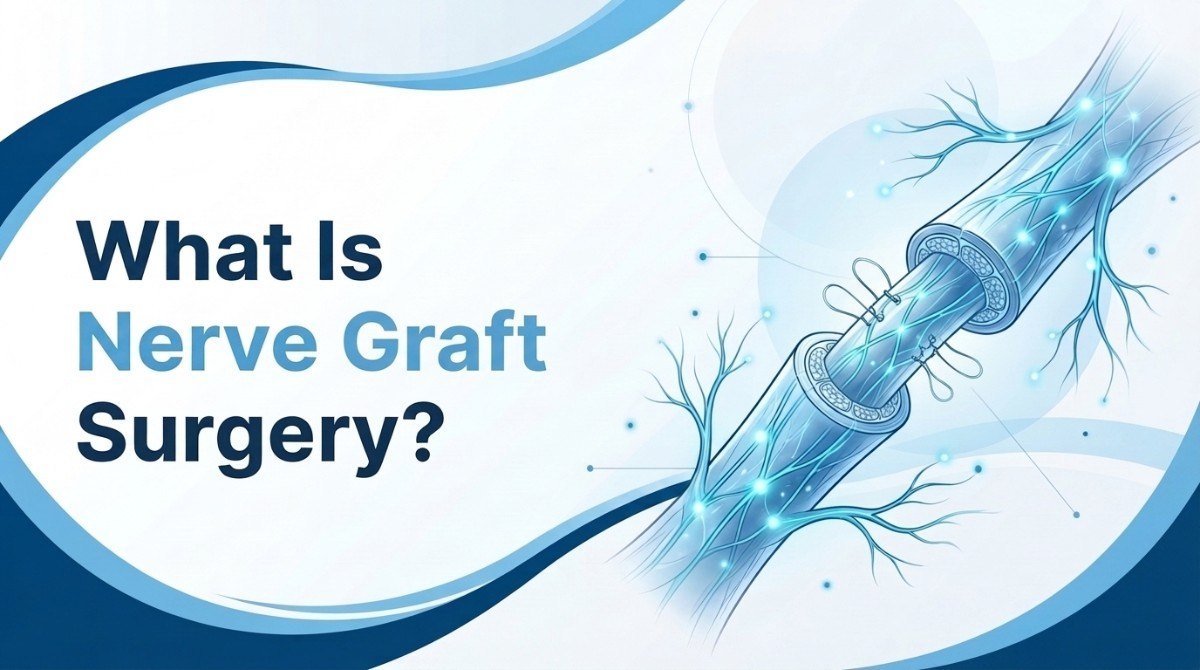
What Is Nerve Graft Surgery? 7 Important Facts
What Is Nerve Graft Surgery ? it is a specialised surgical procedure used to treat certain severe nerve injuries where the damaged nerve ends cannot be reconnected directly without excessive tension. During this procedure, a segment of suitable nerve tissue is used to bridge the gap between the healthy portions of the injured nerve, providing a pathway for regenerating nerve fibres to grow towards the affected muscles and sensory areas.
Peripheral nerves transmit signals between the brain, spinal cord, muscles, and different parts of the body. When these nerves sustain significant damage, patients may experience muscle weakness, numbness, tingling, pain, or loss of movement. Depending on the location and severity of the injury, nerve grafting may be considered as part of a reconstructive treatment plan to restore nerve continuity and support functional recovery.
Understanding the surgical procedure, different types of nerve grafts, treatment considerations, and recovery process can help patients make informed decisions about managing nerve injuries.
What Is Nerve Graft Surgery and How Does It Work?
Nerve graft surgery is a reconstructive procedure performed when a damaged nerve has a gap that cannot be closed through direct nerve repair without excessive tension.
A healthy nerve normally carries electrical signals through specialised fibres called axons. When an injury causes a section of the nerve to become severely damaged or disconnected, these signals may no longer reach the muscles or sensory areas supplied by that nerve.
During nerve grafting, the surgeon uses a suitable segment of nerve tissue to connect the healthy portions on either side of the damaged area. This graft acts as a biological pathway that guides regenerating nerve fibres across the gap.
The main objectives of nerve graft surgery include:
Bridging a gap between damaged nerve ends.
Providing a pathway for regenerating nerve fibres.
Supporting the recovery of muscle function and sensation.
Reconstructing nerves affected by severe traumatic injuries.
Improving the possibility of functional recovery in selected patients.
Nerve grafting does not immediately restore normal nerve function. The nerve fibres must gradually regenerate through the graft and reach their intended targets. Therefore, functional improvement may take several months or longer.
Why Is Nerve Graft Surgery Needed?
Not every nerve injury requires grafting. Some damaged nerves can be reconnected directly, while others may recover naturally with appropriate observation and treatment.
However, when a nerve has sustained extensive damage and a significant gap remains between its healthy ends, direct repair may not be possible without creating excessive tension.
In these situations, nerve grafting may be considered.
Common situations in which nerve graft surgery may be recommended include:
1. Severe Traumatic Nerve Injuries
Road traffic accidents, industrial injuries, deep cuts, and crush injuries can cause extensive damage to peripheral nerves.
When the injured section cannot be preserved and a gap remains after removing unhealthy nerve tissue, grafting may be required to restore continuity.
2. Brachial Plexus Injuries
The brachial plexus is a network of nerves extending from the neck towards the shoulder, arm, and hand. It controls important movements and sensory functions of the upper limb.
Severe brachial plexus injuries may involve stretching, tearing, or complete disruption of nerve structures.
Depending on the location and severity of the injury, treatment may involve nerve grafting, nerve transfer, or a combination of reconstructive procedures.
3. Nerve Damage Following Deep Cuts
Sharp injuries involving the arms, hands, or other body regions may completely divide a nerve.
If the nerve ends cannot be reconnected directly without tension, a suitable nerve graft may be used to bridge the gap.
4. Extensive Nerve Damage After Previous Treatment
Some patients may have persistent nerve dysfunction following previous nerve repair or other procedures. If specialist evaluation identifies a reconstructable nerve defect, further surgical treatment may be considered.
The decision depends on the condition of the remaining nerve tissue, the available treatment options, and the expected functional benefits.
5. Nerve Injuries Associated With Tumours
In selected cases, removing a nerve tumour or other abnormal tissue may leave a gap in the nerve. Nerve reconstruction, including grafting, may be considered depending on the affected nerve and the functional requirements.
What Are the Different Types of Nerve Grafts?
Nerve grafts can be classified according to the source of the nerve tissue used during reconstruction.
1. Autologous Nerve Graft
An autologous nerve graft uses a segment of nerve tissue taken from another part of the same patient’s body.
This is a commonly used approach in peripheral nerve reconstruction.
The surgeon selects a suitable donor nerve that can be harvested without causing unacceptable functional problems.
One commonly used donor nerve is the sural nerve, located in the lower leg. It is primarily a sensory nerve and can provide nerve tissue for reconstruction in selected cases.
Other donor nerves may also be considered depending on the location and requirements of the injury.
Important considerations include:
The length of nerve tissue required.
The suitability of the donor nerve.
Possible sensory changes at the donor site.
The location and size of the damaged nerve.
The overall functional requirements of the patient.
2. Allograft Nerve Graft
An allograft uses nerve tissue obtained from a human donor. The nerve tissue is processed before being used in reconstruction.
Processed nerve allografts are designed to provide a pathway for regenerating nerve fibres without requiring the patient to undergo a separate donor nerve harvesting procedure.
Their suitability depends on factors such as the nerve defect, its location, and the available clinical evidence.
The surgeon evaluates whether an allograft is appropriate for the individual case.
3. Nerve Conduits and Alternative Grafting Materials
In selected peripheral nerve injuries, specialised nerve conduits or other bridging materials may be considered.
These structures are designed to guide nerve regeneration across certain nerve gaps. Their use depends on the size, location, and characteristics of the injury.
They are not suitable for every type of nerve reconstruction, particularly complex injuries involving larger nerve structures.
How Is Nerve Graft Surgery Performed?
Nerve graft surgery requires careful surgical planning and precise microsurgical techniques. The procedure varies according to the location of the damaged nerve, the length of the gap, and the type of graft selected.
The general stages include:
1. Preoperative Assessment
Before surgery, the specialist evaluates the patient’s injury history, symptoms, and functional limitations.
The assessment may include:
Clinical examination of muscle strength.
Evaluation of sensory function.
Assessment of joint movement.
Identification of the affected nerve.
Review of previous treatments and investigations.
Nerve conduction studies and electromyography (EMG) may be recommended to assess nerve function. Imaging investigations may also be used to understand the extent and location of the injury.
2. Identification of the Damaged Nerve
During surgery, the affected nerve is carefully exposed. The surgeon examines the damaged area and identifies healthy nerve tissue on either side of the injury.
Unhealthy or severely scarred nerve tissue may need to be removed to prepare suitable ends for reconstruction.
3. Selection of the Nerve Graft
The surgeon determines the appropriate graft according to the size and length of the nerve defect.
If an autologous graft is selected, the required nerve segment is carefully harvested from a suitable donor site.
If an alternative graft is appropriate, it is prepared according to the surgical requirements.
4. Placement of the Nerve Graft
The prepared graft is positioned between the healthy ends of the damaged nerve.
Using microsurgical magnification and specialised instruments, the surgeon carefully connects the graft to both nerve ends.
Achieving appropriate alignment and avoiding excessive tension are important considerations during this stage.
5. Closure and Postoperative Care
After completing the reconstruction, the surgical area is closed and protected.
Depending on the procedure, the patient may need a splint or other support to limit movement during the initial healing period.
Postoperative instructions generally include wound care, activity restrictions, follow-up examinations, and rehabilitation guidance.
What Is the Difference Between Nerve Repair and Nerve Graft Surgery?
Nerve repair and nerve grafting are both surgical techniques used to manage damaged peripheral nerves. However, they are selected according to different injury characteristics.
Direct nerve repair involves reconnecting the two healthy ends of a damaged nerve when they can be brought together without excessive tension.
Nerve graft surgery is used when a gap remains between the healthy nerve ends and direct reconnection is not suitable.
The main differences include:
| Factor | Direct Nerve Repair | Nerve Graft Surgery |
|---|---|---|
| Surgical approach | Directly reconnects nerve ends | Uses a nerve segment to bridge the gap |
| Nerve gap | No significant gap preventing direct repair | A gap exists between healthy nerve ends |
| Donor nerve | Generally not required | May be required depending on graft type |
| Surgical complexity | Depends on injury location and condition | Involves additional graft selection and placement |
| Recovery | Varies according to injury | Depends on graft length, injury and nerve regeneration |
The decision between these techniques requires an individual assessment. Nerve grafting is not automatically better than direct repair; the most appropriate procedure depends on the injury.
What Is the Recovery Process After Nerve Graft Surgery?
Recovery after nerve graft surgery is gradual because peripheral nerve fibres need time to regenerate through the graft and reach their target muscles and sensory areas.
The recovery period varies according to the type of injury, the length of the graft, the location of the damaged nerve, and the patient’s overall condition.
1. Initial Postoperative Recovery
During the early recovery period, patients may need to protect the operated area and follow specific movement restrictions.
A splint or support may be recommended to protect the reconstructed nerve.
The surgeon provides instructions regarding wound care, medication, follow-up visits, and the gradual return to daily activities.
2. Nerve Regeneration
Following surgery, regenerating nerve fibres gradually grow through the graft towards their intended targets.
The distance between the repair site and the affected muscles or sensory areas influences the time required for functional improvement.
Patients should understand that nerve graft surgery does not produce immediate restoration of movement or sensation.
3. Physiotherapy and Rehabilitation
Rehabilitation plays an important role in managing the effects of nerve injuries.
Depending on the patient’s condition, physiotherapy or occupational therapy may help:
Maintain joint flexibility.
Reduce the risk of stiffness.
Support the function of unaffected muscles.
Improve coordination and movement.
Maintain the functional use of the affected limb.
Adapt everyday activities during recovery.
The rehabilitation programme should be personalised according to the surgical findings and the patient’s progress.
What Are the Risks and Possible Complications of Nerve Graft Surgery?
Like other surgical procedures, nerve graft surgery involves potential risks. The nature and likelihood of complications depend on the patient’s condition, the type of graft, and the complexity of the operation.
Possible considerations include:
Infection at the surgical site.
Bleeding or swelling.
Scar formation.
Delayed wound healing.
Incomplete recovery of nerve function.
Persistent numbness or weakness.
Sensory changes or discomfort at the donor site when an autologous graft is used.
Failure to achieve the expected functional improvement.
Patients should discuss the possible benefits, limitations, and risks with their surgeon before deciding on treatment.
What Factors Influence the Success of Nerve Graft Surgery?
The outcome of nerve graft surgery depends on several factors. Although the procedure aims to provide a pathway for nerve regeneration, complete restoration of normal function cannot be guaranteed.
Severity of the Original Injury
Extensive nerve damage may affect the amount of healthy nerve tissue available for reconstruction.
Length of the Nerve Gap
Longer nerve gaps may present additional challenges because regenerating fibres need to travel a greater distance.
Location of the Injury
The distance between the graft and the target muscles or sensory areas influences the time required for regeneration.
Timing of Surgical Treatment
Early evaluation is important because prolonged nerve dysfunction may affect the available treatment options and functional recovery potential.
Patient’s Age and Overall Health
Individual health factors may influence the healing process and rehabilitation.
Surgical Planning and Rehabilitation
Appropriate graft selection, precise surgical technique, follow-up assessments, and structured rehabilitation are important considerations throughout treatment.
Why Is Specialist Evaluation Important for Nerve Grafting?
Nerve injuries can vary significantly in their location, severity, and functional impact. Some injuries can be managed without surgery, while others may require specialised reconstruction.
A specialist evaluation helps determine whether direct nerve repair, nerve grafting, nerve transfer, or another treatment approach is appropriate.
For complex brachial plexus injuries, the surgeon must also consider which nerve structures are affected and whether additional reconstructive procedures may be required.
Patients experiencing persistent weakness, numbness, loss of movement, or other symptoms following an injury should seek timely medical assessment.
Nerve Graft Surgery Consultation With Dr. Pradeep Kumar in Thrissur
Patients looking for a Brachial Plexus Surgery Doctor in Kerala, particularly those seeking specialist consultation in Thrissur, can consult Dr. Pradeep Kumar, a Plastic and Reconstructive Surgeon specialising in brachial plexus and peripheral nerve surgery.
Dr. Pradeep Kumar evaluates patients with complex nerve injuries and discusses suitable treatment options based on their clinical condition, diagnostic findings, and functional requirements.
At the Sushrutha Institute of Plastic, Reconstructive and Aesthetic Surgery, Elite Mission Hospital, Thrissur, patients can undergo specialist assessment for nerve-related conditions and discuss appropriate surgical approaches.
Nerve grafting may be considered when a damaged nerve has a gap that cannot be managed through direct repair without excessive tension. The choice of surgical approach depends on the location and extent of nerve damage, the available healthy nerve tissue, and the patient’s functional requirements.
Individuals seeking a Nerve Graft Surgery consultation in Kerala can consult Dr. Pradeep Kumar in Thrissur to understand their condition, available surgical approaches, and expected recovery considerations.
Understanding Nerve Graft Surgery
Nerve graft surgery is an important reconstructive option for selected peripheral nerve injuries where direct nerve repair is not possible without excessive tension. By using a suitable nerve segment to bridge the damaged area, the procedure provides a pathway for regenerating nerve fibres.
Understanding the different graft types, surgical techniques, and recovery considerations can help patients make informed decisions about their treatment.
Early specialist evaluation, appropriate surgical planning, and structured rehabilitation are important parts of managing complex nerve injuries. A personalised assessment helps determine whether nerve grafting or another reconstructive procedure is suitable for the individual patient.
- Brachial Plexus Surgery in Kerala
- What Is Nerve Repair Surgery?
- What Is Nerve Graft Surgery?
- Nerve Repair vs Nerve Graft
- When Is Nerve Grafting Needed?
- Recovery After Nerve Graft Surgery
- Can a Damaged Nerve Be Repaired?
- How Long Does Nerve Repair Take to Heal?
- Brachial Plexus Injury Specialist in Kerala
- Brachial Plexus Surgery Specialist in Kerala
- Brachial Plexus Reconstruction in Kerala

Dr. Pradeep Kumar
Plastic & Reconstructive Surgeon – Brachial Plexus & Nerve Surgery Specialist
Dr. Pradeep Kumar is an experienced plastic and reconstructive surgeon known for his expertise in brachial plexus and peripheral nerve surgery. With extensive microsurgical experience, he focuses on restoring movement and function for patients with complex nerve injuries.
Sushrutha Institute of Plastic Surgery, Elite Mission Hospital, Thrissur
Frequently Asked Questions
Nerve graft surgery is a reconstructive procedure used to bridge a gap between damaged nerve ends when they cannot be reconnected directly without excessive tension. A suitable nerve graft provides a pathway for regenerating nerve fibres to grow towards the affected area.
Nerve graft surgery may be considered when an injury causes a significant gap in a nerve or damages a section that cannot be repaired directly. The decision depends on the injury, nerve condition, gap length and clinical assessment.
Patients with certain severe peripheral nerve injuries may be candidates for nerve graft surgery, particularly when the damaged nerve ends cannot be joined directly. A specialist evaluates the injury, nerve function, medical history and investigation results before recommending the procedure.
Nerve graft tissue may come from another suitable nerve in the patient's body, known as an autograft. In selected cases, processed donor nerve tissue or other suitable nerve reconstruction materials may be considered depending on the clinical situation.
Recovery varies according to the nerve injured, the location and length of the graft, the severity of the injury and the patient's overall health. Nerve regeneration is generally gradual, and improvements in sensation or movement may take several months or longer.
Nerve graft surgery aims to restore nerve continuity and support regeneration, but complete recovery is not guaranteed. The outcome depends on factors such as the type and severity of the injury, the time before treatment, the distance the nerve fibres must regenerate and the condition of the affected muscles.