10 Essential Frequently Asked Questions About Brachial Plexus Surgery
When a brachial plexus injury affects the shoulder, arm, wrist, or hand, patients often have many questions about diagnosis, surgery, recovery, and long-term function. Frequently Asked Questions can help patients understand what to expect before discussing their condition with a specialist. For patients considering treatment in Kerala, understanding the basics of brachial plexus surgery can make the consultation process clearer and more useful.
The brachial plexus is a network of nerves that connects the spinal cord to the shoulder, arm, forearm, and hand. Damage to these nerves can cause weakness, numbness, pain, loss of movement, or paralysis. While some nerve injuries may recover without surgery, more serious injuries may require microsurgical procedures such as nerve repair, nerve grafting, or nerve transfer.
This guide answers common Frequently Asked Questions related specifically to brachial plexus surgery, including when surgery may be needed, the procedures used, recovery expectations, rehabilitation, and factors that influence treatment decisions.
What Is Brachial Plexus Surgery
Brachial plexus surgery is a specialized surgical treatment used to restore or improve function after significant damage to the brachial plexus nerves.
The brachial plexus contains several nerves that control movement and sensation in the upper limb. When these nerves are severely stretched, torn, compressed, or separated from their roots, normal nerve signals may not reach the muscles.
Depending on the injury, surgery may involve:
- Nerve repair
- Nerve grafting
- Nerve transfer
- Nerve decompression
- Tendon transfer
- Muscle transfer
- Free functional muscle transfer
The exact procedure depends on the type, location, and severity of the injury.
The primary aim is to restore useful movement and function rather than simply repair the appearance of a damaged nerve.
When Is Brachial Plexus Surgery Needed
One of the most important Frequently Asked Questions is whether every brachial plexus injury requires surgery.
The answer is no.
Some mild injuries may recover naturally with observation, physiotherapy, occupational therapy, and appropriate rehabilitation. Surgery is generally considered when the injury is severe or when meaningful spontaneous recovery is unlikely.
A specialist may consider surgery when there is:
- Complete nerve rupture
- Nerve root avulsion
- Severe and persistent weakness
- Loss of arm movement
- Significant muscle wasting
- Persistent neurological deficits
- Little or no evidence of nerve recovery
- Severe functional impairment
The decision is based on clinical examination, imaging, electrodiagnostic studies, the patient’s age, the injury pattern, and the time elapsed since the injury.
What Causes Injuries That May Require Brachial Plexus Surgery
Brachial plexus injuries can occur in several situations.
Common causes include:
Road Traffic Accidents
Motorcycle and automobile accidents can create powerful traction forces around the neck and shoulder, potentially damaging several nerves.
Sports Injuries
Contact sports and high-impact activities may cause stretching or compression of the brachial plexus.
Falls
Falls from significant heights can cause severe traction injuries involving the shoulder and neck.
Workplace Injuries
Industrial accidents involving heavy machinery or sudden trauma may damage the nerve network.
Birth-Related Injuries
Difficult childbirth can sometimes result in brachial plexus injuries in newborns.
Penetrating Injuries
Direct trauma can damage individual nerves or multiple parts of the brachial plexus.
Understanding the cause helps the specialist determine the likely pattern of nerve damage and select appropriate investigations and treatment.
What Are the Signs That Surgery May Be Required
Symptoms vary according to which nerves have been damaged.
Possible signs of a serious brachial plexus injury include:
- Complete or significant loss of arm movement
- Difficulty lifting the shoulder
- Weakness when bending the elbow
- Poor wrist movement
- Weak grip
- Numbness
- Loss of sensation
- Severe nerve pain
- Muscle wasting
- Persistent weakness following an accident
- Paralysis affecting part or all of the arm
Not every symptom automatically means that surgery is required.
For example, a patient with a mild nerve stretch injury may recover naturally, whereas someone with a complete nerve rupture or avulsion may require reconstruction.
A specialist assessment is therefore essential before deciding whether surgery is appropriate.
How Is a Brachial Plexus Injury Diagnosed Before Surgery
Accurate diagnosis is one of the most important steps in treatment planning.
The evaluation usually starts with a detailed physical examination. The specialist may assess:
- Muscle strength
- Sensation
- Reflexes
- Joint movement
- Grip strength
- Shoulder function
- Distribution of weakness
- Signs of muscle wasting
Additional tests may be recommended.
MRI
MRI can provide detailed information about nerves and surrounding soft tissues.
CT Myelography
CT myelography can help identify certain nerve root injuries, including avulsion in appropriate cases.
Electromyography
EMG evaluates electrical activity in muscles and can provide information about nerve and muscle function.
Nerve Conduction Studies
NCS evaluates how electrical signals travel through nerves.
These investigations help the surgical team understand the location and severity of the injury and determine whether nerve reconstruction may be beneficial.
What Types of Brachial Plexus Surgery Are Available
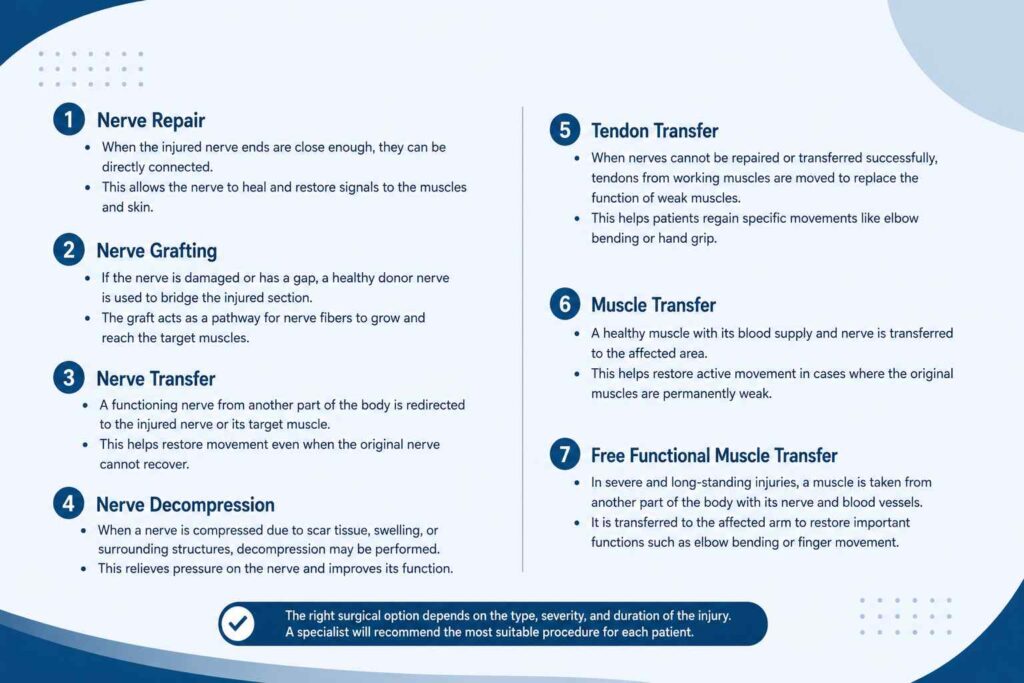
Another common question concerns the different surgical techniques.
Nerve Repair
If the damaged nerve ends can be directly connected without excessive tension, nerve repair may be considered.
Nerve Grafting
When a section of nerve is damaged and direct repair is not possible, a healthy nerve graft may be used to bridge the gap.
The objective is to provide a pathway through which nerve fibres can regenerate toward the target muscles.
Nerve Transfer
In a nerve transfer, a functioning nerve or part of a functioning nerve is redirected to an injured nerve or its target.
Nerve transfers can be particularly useful in certain severe injuries where direct repair or grafting may not provide the desired result.
Tendon Transfer
In selected patients, functioning tendons can be repositioned to improve specific movements.
Muscle Transfer
A functioning muscle may be transferred to restore a particular lost function.
Free Functional Muscle Transfer
In selected complex or longstanding injuries, microsurgical transfer of functional muscle may be considered.
The appropriate procedure depends on the individual’s injury and functional goals.
What Is the Difference Between Nerve Grafting and Nerve Transfer
This is one of the most useful Frequently Asked Questions for patients preparing for a surgical consultation.
With nerve grafting, a damaged section of nerve is bridged using a healthy donor nerve. The graft provides a pathway for nerve regeneration.
With nerve transfer, a functioning nerve is redirected to restore activity in an affected nerve or muscle.
The choice between these techniques depends on:
- Location of the injury
- Type of nerve damage
- Length of the damaged nerve segment
- Time since injury
- Available functioning donor nerves
- Muscles that need to be restored
- Overall functional goals
A patient should not assume that one procedure is universally better than the other. The surgical plan must be individualized.
How Important Is the Timing of Brachial Plexus Surgery
Timing can be an important factor in treatment planning.
Severely injured nerves may have limited ability to restore useful muscle function if treatment is delayed for too long. Muscles that remain without adequate nerve supply for prolonged periods may undergo changes that can affect later recovery.
However, there is no single surgical timeline that applies to every patient.
The appropriate timing depends on:
- Type of injury
- Severity of nerve damage
- Age of the patient
- Evidence of spontaneous recovery
- Results of EMG and nerve studies
- Imaging findings
- Muscles affected
- Time since injury
Early specialist evaluation allows the injury to be assessed and monitored appropriately. It also helps determine whether observation, rehabilitation, or surgical reconstruction is appropriate.
What Is Recovery Like After Brachial Plexus Surgery
Recovery from brachial plexus surgery is usually gradual.
Patients should understand that nerve recovery is different from recovery after procedures involving bones or skin. Nerves regenerate slowly, so improvement may take many months.
Recovery may involve:
- Pain management
- Protective immobilization initially
- Physiotherapy
- Occupational therapy
- Muscle re-education
- Range-of-motion exercises
- Strengthening exercises
- Functional training
- Regular clinical follow-up
The exact rehabilitation plan depends on the procedure performed.
Some patients may notice gradual improvement over several months, while functional recovery can continue for one to two years or longer in certain cases.
The outcome cannot be predicted solely from the surgery itself. Rehabilitation, the original severity of injury, nerve regeneration, and individual healing all influence recovery.
Is Physiotherapy Necessary After Brachial Plexus Surgery
Yes. Rehabilitation is a major component of the overall treatment process.
Surgery can create a pathway for nerve regeneration, but rehabilitation helps the affected limb maintain mobility and develop useful function.
Physiotherapy may focus on:
- Maintaining joint movement
- Preventing stiffness
- Preserving muscle condition
- Improving strength as nerve function returns
- Supporting shoulder movement
- Improving coordination
- Developing functional movement
Occupational therapy may also help patients adapt to changes in arm or hand function and perform everyday activities more independently.
Patients should follow the rehabilitation program provided by their healthcare team rather than performing exercises without professional guidance.
How Long Does Recovery Take After Brachial Plexus Surgery
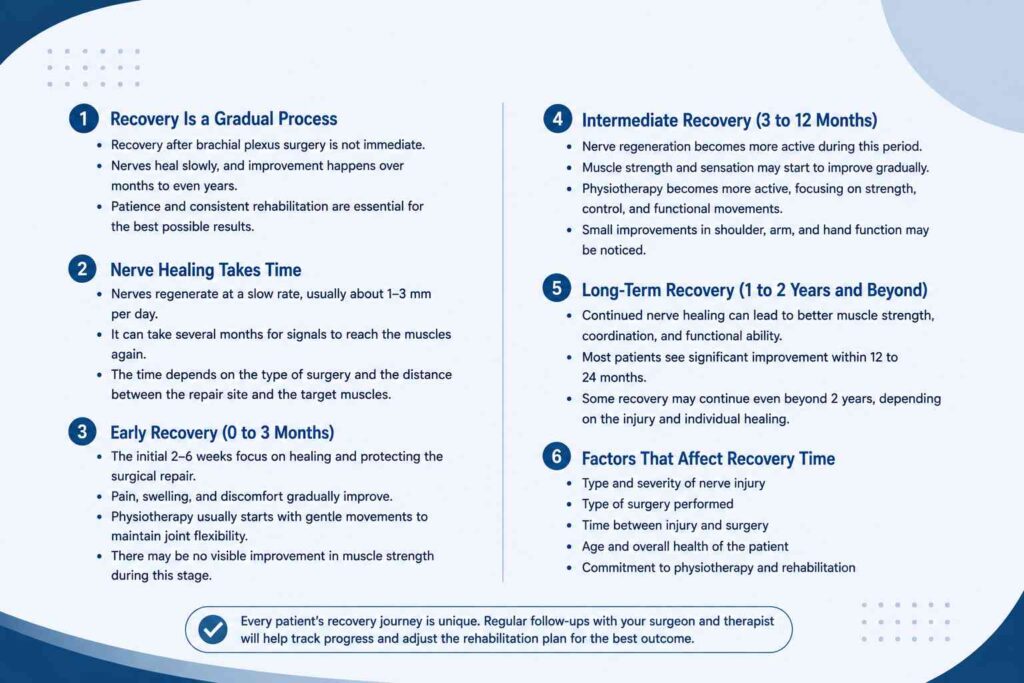
Recovery time differs from patient to patient.
Several factors influence recovery, including:
- Severity of the nerve injury
- Type of surgery
- Nerves involved
- Patient age
- Timing of treatment
- Muscle condition
- Rehabilitation
- Individual nerve regeneration
Nerves regenerate slowly, so recovery should be viewed as a long-term process.
A patient may initially focus on protecting the surgical repair. Later stages may focus on maintaining joint mobility, strengthening recovering muscles, and retraining functional movements.
It is important not to become discouraged if improvement is slow. Nerve recovery may continue for many months, and functional gains can occur gradually.
At the same time, patients should understand that surgery cannot guarantee complete restoration of normal function.
What Are the Possible Benefits of Brachial Plexus Surgery
The potential benefits depend on the nature of the injury and the procedure performed.
Possible benefits may include:
- Improved arm movement
- Better shoulder function
- Improved elbow movement
- Increased grip strength
- Improved hand function
- Better muscle control
- Reduction in certain types of nerve-related pain
- Greater independence
- Improved ability to perform daily activities
- Better overall quality of life
The goal of treatment is usually to achieve the greatest practical functional improvement possible.
Patients should discuss expected outcomes with their specialist because the potential benefits vary according to the individual injury.
What Are the Risks of Brachial Plexus Surgery
Like any major surgical procedure, brachial plexus surgery has potential risks.
Possible complications can include:
- Infection
- Bleeding
- Scar formation
- Persistent pain
- Nerve-related pain
- Stiffness
- Delayed healing
- Limited nerve recovery
- Muscle weakness
- Anaesthesia-related complications
The risk profile varies according to the procedure and the patient’s individual circumstances.
A detailed consultation allows patients to understand the potential benefits, limitations, and risks before making treatment decisions.
How Can Patients Prepare for Brachial Plexus Surgery
Preparation can help patients approach surgery with realistic expectations.
Before surgery, patients may undergo:
- Physical examination
- Imaging studies
- EMG or nerve conduction testing
- Blood investigations
- Medication review
- Medical fitness assessment
Patients should provide their healthcare team with information about existing medications, previous operations, allergies, and other relevant medical history.
It is also useful to understand the rehabilitation process before surgery.
Patients should ask about:
- Expected hospital stay
- Postoperative restrictions
- Rehabilitation requirements
- Follow-up schedule
- Expected recovery milestones
- When normal activities may gradually resume
Understanding the recovery process beforehand can help patients and families plan for the postoperative period.
What Factors Should You Consider When Choosing a Brachial Plexus Surgery Specialist
Choosing a specialist is an important decision because brachial plexus surgery involves delicate nerves and microsurgical techniques.
Patients may consider:
- Experience with brachial plexus injuries
- Expertise in peripheral nerve surgery
- Microsurgical experience
- Experience with nerve grafting
- Experience with nerve transfers
- Availability of diagnostic evaluation
- Rehabilitation planning
- Long-term follow-up
- Ability to provide individualized treatment recommendations
Patients should also ask the specialist to explain the diagnosis, proposed procedure, expected goals, possible risks, and rehabilitation requirements.
The objective is to select treatment based on the individual injury rather than simply choosing a procedure.
Can Children Need Brachial Plexus Surgery
Yes. Brachial plexus injuries can occur during childbirth and may affect a child’s arm movement.
Some newborns recover naturally, while others may have persistent weakness or functional limitations.
Parents may notice:
- Reduced movement of one arm
- Weak shoulder movement
- Difficulty bending the elbow
- An unusual resting position of the arm
- Reduced hand or wrist movement
Children with suspected birth-related brachial plexus injuries should be assessed and monitored appropriately.
If recovery does not progress as expected, specialist treatment may be considered.
The timing and type of treatment for children differ from those for adults and should be determined based on the child’s individual condition.
What Should Patients Expect From Long-Term Rehabilitation
Long-term rehabilitation is often essential following complex brachial plexus injuries.
The rehabilitation process may change as nerve function returns.
Early rehabilitation may focus on protecting the repair and maintaining joint mobility.
Later rehabilitation may focus on:
- Muscle activation
- Strengthening
- Movement retraining
- Grip training
- Hand coordination
- Shoulder stability
- Functional activities
- Sensory re-education
Regular follow-up helps assess whether the affected muscles are responding to nerve regeneration.
Patients should understand that rehabilitation is not simply an additional part of treatment. It is an important component of maximizing the functional benefits of nerve reconstruction.
What Questions Should You Ask Before Brachial Plexus Surgery
Preparing questions before a consultation can help patients understand their treatment plan.
Important questions may include:
- What type of brachial plexus injury do I have?
- Which nerves are affected?
- Is spontaneous recovery possible?
- Do I need surgery?
- Which surgical procedure is recommended?
- Why is this procedure suitable for my injury?
- Would nerve grafting or nerve transfer be appropriate?
- What are the expected benefits?
- What are the possible risks?
- How long may recovery take?
- What rehabilitation will I need?
- How will my progress be monitored?
Clear communication between the patient and healthcare team is essential for setting realistic expectations.
Conclusion
Understanding Frequently Asked Questions about brachial plexus surgery can help patients make informed decisions about diagnosis, treatment, surgery, and rehabilitation. Brachial plexus injuries can vary from mild nerve stretching to severe rupture or avulsion, so treatment must be individualized according to the injury pattern and the patient’s functional needs.
Some patients may recover with observation and rehabilitation, while others may benefit from procedures such as nerve repair, nerve grafting, nerve transfer, tendon transfer, or muscle transfer. Early evaluation is important because the timing of treatment can influence the potential for useful nerve and muscle recovery.
Recovery after brachial plexus surgery is gradual and requires patience, physiotherapy, occupational therapy, and regular follow-up. Patients considering treatment should discuss their diagnosis, surgical options, expected outcomes, risks, and rehabilitation plan with a qualified specialist.
For anyone researching Frequently Asked Questions about brachial plexus surgery and considering specialist evaluation in Kerala, understanding these key points can provide a useful foundation before a detailed medical consultation. For reliable information on brachial plexus injuries and their management, visit the Mayo Clinic – Brachial Plexus Injury.
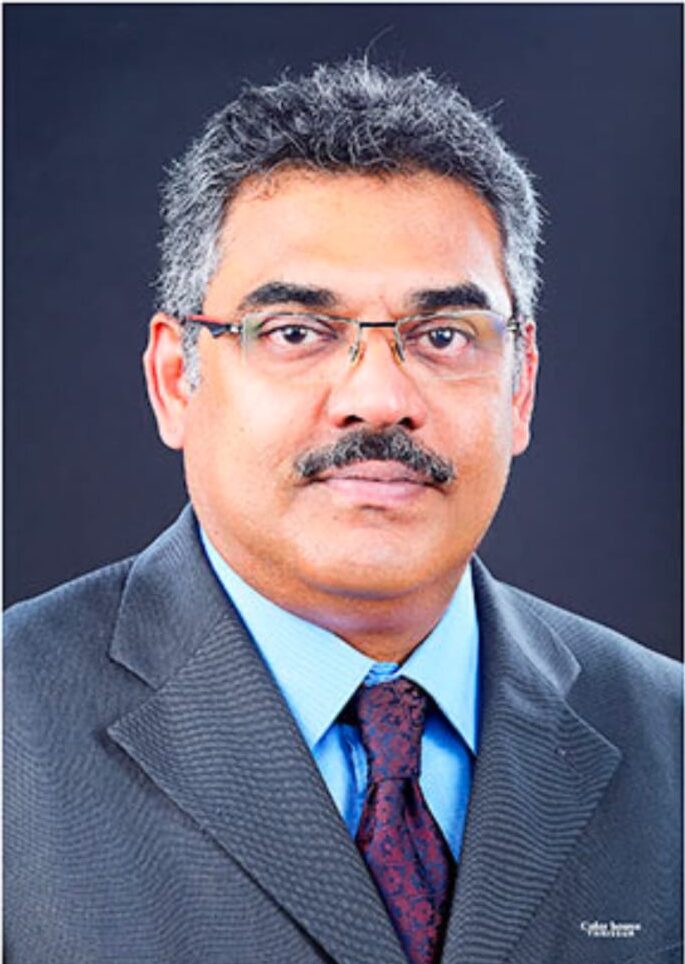
Dr. Pradeep Kumar
Plastic & Reconstructive Surgeon – Brachial Plexus & Nerve Surgery Specialist
Dr. Pradeep Kumar is an experienced plastic and reconstructive surgeon known for his expertise in brachial plexus and peripheral nerve surgery. With extensive microsurgical experience, he focuses on restoring movement and function for patients with complex nerve injuries.
Sushrutha Institute of Plastic Surgery, Elite Mission Hospital, Thrissur