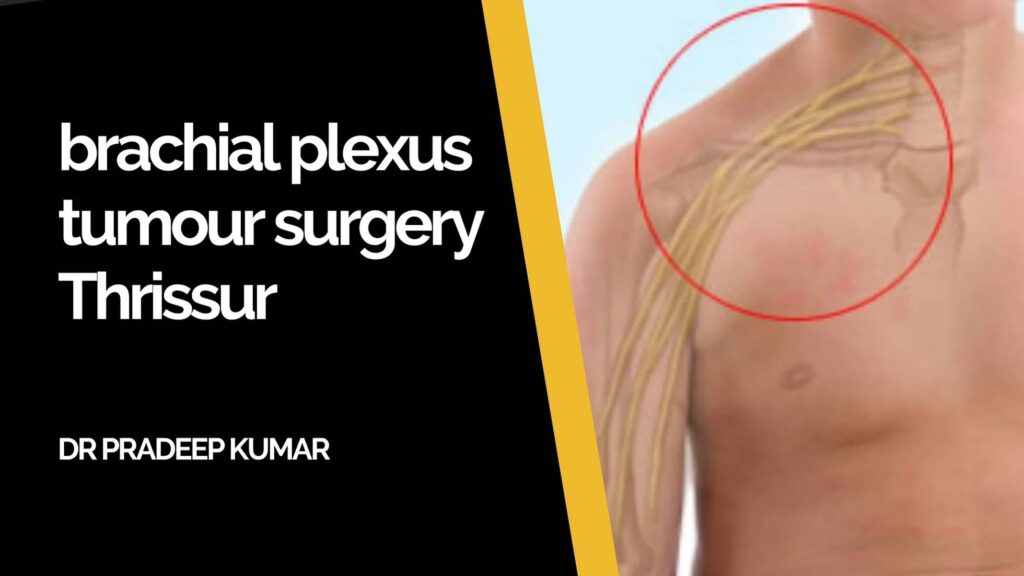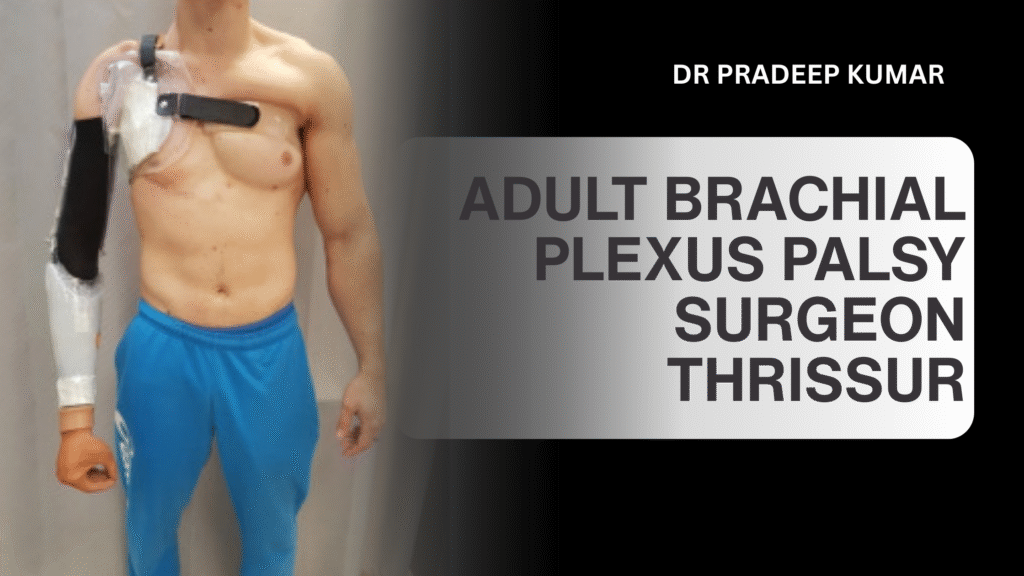
A shoulder injury can happen after a fall, sports accident, road traffic accident, heavy lifting, or a sudden impact. While some injuries cause temporary pain and stiffness, certain symptoms may indicate a more serious problem involving the bones, muscles, tendons, ligaments, nerves, or blood vessels. Recognizing these warning signs early can help you seek appropriate medical care before the injury becomes more difficult to manage.
Symptoms such as severe pain, sudden swelling, inability to move the arm, visible deformity, numbness, or significant weakness should not be dismissed after an injury. Mayo Clinic recommends immediate medical attention when an injury causes severe pain, sudden swelling, shoulder deformity, exposed bone or tendon, or an inability to raise the arm.
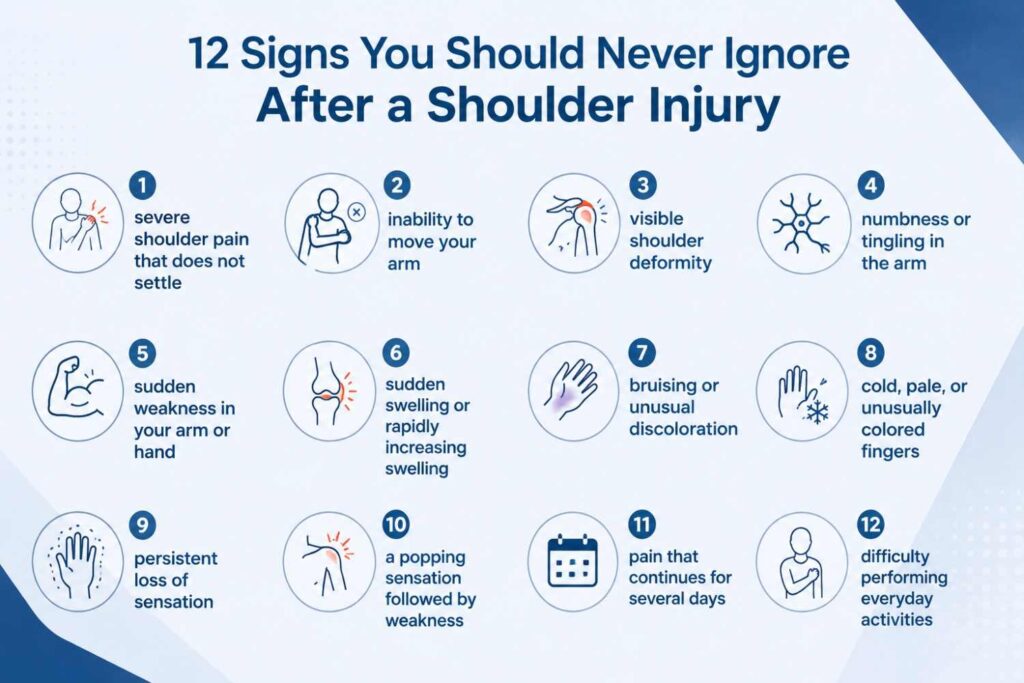
1. severe shoulder pain that does not settle
Pain is a common part of many shoulder injuries, but intense or worsening pain deserves attention.Severe pain immediately after trauma may occur with conditions such as a fracture, dislocation, significant tendon injury, or other structural damage. If the pain is becoming worse rather than gradually improving, medical evaluation is important.Do not assume that severe pain is simply a normal part of recovery. A proper examination can help identify the underlying cause.
2. inability to move your arm
One of the most important symptoms you should never ignore after a shoulder injury is a sudden inability to move your shoulder or arm.
Difficulty moving the arm can occur with:
- Shoulder dislocation
- Fracture
- Significant tendon injury
- Severe muscle damage
- Nerve injury
- Other structural problems
If movement suddenly becomes impossible following trauma, avoid forcing the shoulder and seek medical attention.
3. visible shoulder deformity
A shoulder that suddenly looks different after an accident may indicate a dislocation, fracture, or another significant injury.
You may notice:
- An unusual shoulder shape
- A prominent area around the joint
- A visible change in alignment
- A lump or abnormal contour
- Difficulty keeping the arm in its normal position
A visibly deformed shoulder following trauma requires prompt medical evaluation.Never attempt to push a potentially dislocated shoulder back into position yourself. Doing so can cause additional damage to nerves, blood vessels, muscles, or other tissues.
4. numbness or tingling in the arm
Numbness and tingling after a shoulder injury may suggest that a nerve has been affected.Peripheral nerves can be stretched, compressed, crushed, or injured during trauma. Symptoms may include:
- Numbness
- Tingling
- Altered sensation
- Burning sensations
- Weakness
- Loss of feeling
Persistent numbness, tingling, or weakness should be assessed by a healthcare professional because early evaluation of a nerve injury can be important.This is particularly relevant after a major shoulder injury because some shoulder conditions can involve nearby nerves.
5. sudden weakness in your arm or hand
Pain is not the only warning sign after shoulder trauma. New weakness in the arm, wrist, or hand may indicate a significant injury.For example, rotator cuff injuries can cause shoulder weakness and difficulty lifting or rotating the arm. Nerve injuries can also produce weakness depending on which nerve has been affected.If you suddenly cannot lift an object that you could previously handle or cannot raise your arm normally after an injury, arrange a medical assessment.
6. sudden swelling or rapidly increasing swelling
Some swelling can occur after trauma, but sudden or progressively increasing swelling should not be ignored.Significant swelling may occur with injuries involving:
- Bones
- Muscles
- Tendons
- Ligaments
- Soft tissues
If swelling is accompanied by severe pain, deformity, loss of movement, or changes in sensation, prompt assessment becomes even more important.
7. bruising or unusual discoloration
Bruising can occur after a direct impact, but extensive discoloration combined with other symptoms may require further evaluation.Pay attention if bruising occurs together with:
- Severe pain
- Significant swelling
- Weakness
- Numbness
- Difficulty moving the arm
- A visible change in shoulder shape
A healthcare professional can determine whether the injury is limited to soft tissue or involves a more significant structural problem.
8. cold, pale, or unusually colored fingers
Changes in the temperature or color of the hand or fingers after a shoulder injury should not be overlooked.A shoulder injury can sometimes affect structures around the joint, including blood vessels and nerves. Cleveland Clinic notes that numb or cold fingers after a shoulder separation require medical attention.If your hand becomes unusually cold, pale, blue, or persistently numb following significant trauma, seek urgent medical evaluation.
9. persistent loss of sensation
Temporary altered sensation can occur after an injury, but persistent loss of feeling is a warning sign.Peripheral nerve injuries can cause weakness, tingling, numbness, or complete loss of sensation. Early diagnosis and treatment may help reduce the risk of lasting nerve-related problems.Do not ignore persistent sensory changes simply because the shoulder pain itself is improving.
10. a popping sensation followed by weakness
Some people notice a sudden pop or tearing sensation during a shoulder injury.A popping sensation followed by immediate pain or weakness can occur with certain tendon or soft-tissue injuries. Rotator cuff tears, for example, may produce sudden pain and arm weakness following trauma.If you experience a pop followed by difficulty lifting or rotating the arm, medical evaluation can help determine whether a tendon or other structure has been damaged.
11. pain that continues for several days
Not every shoulder injury requires emergency treatment. However, pain that does not improve or begins getting worse should not be ignored.Cleveland Clinic recommends medical assessment when shoulder pain continues for more than a few days, worsens, or is accompanied by limited arm movement or function.Persistent symptoms can have different causes, including sprains, strains, tendon injuries, rotator cuff problems, or other shoulder conditions.
12. difficulty performing everyday activities
A shoulder injury can become particularly concerning when it interferes with normal activities.
You may have difficulty:
- Dressing
- Combing your hair
- Reaching overhead
- Carrying objects
- Washing your hair
- Reaching behind your back
- Sleeping comfortably
- Using your affected arm
Reduced function can occur with several shoulder conditions. A healthcare professional can assess whether the problem involves the muscles, tendons, joint, nerves, or another structure.
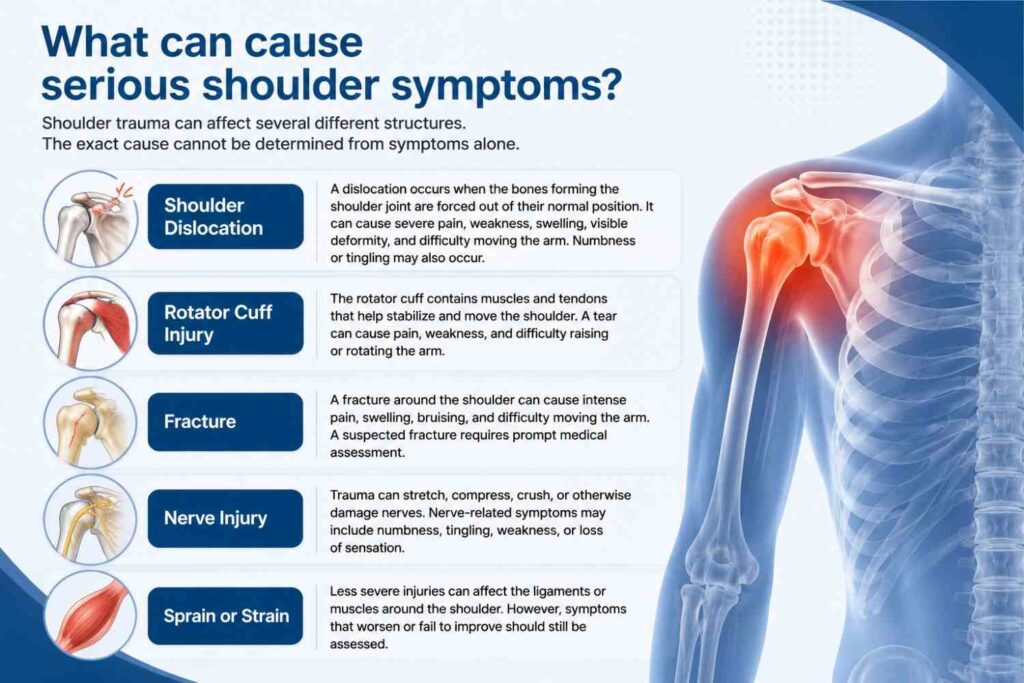
What can cause serious shoulder symptoms?
Shoulder trauma can affect several different structures. The exact cause cannot be determined from symptoms alone.
Possible injuries include:
Shoulder dislocation
A dislocation occurs when the bones forming the shoulder joint are forced out of their normal position. It can cause severe pain, weakness, swelling, visible deformity, and difficulty moving the arm. Numbness or tingling may also occur.
Rotator cuff injury
The rotator cuff contains muscles and tendons that help stabilize and move the shoulder. A tear can cause pain, weakness, and difficulty raising or rotating the arm.
Fracture
A fracture around the shoulder can cause intense pain, swelling, bruising, and difficulty moving the arm. A suspected fracture requires prompt medical assessment.
Nerve injury
Trauma can stretch, compress, crush, or otherwise damage nerves. Nerve-related symptoms may include numbness, tingling, weakness, or loss of sensation.
Sprain or strain
Less severe injuries can affect the ligaments or muscles around the shoulder. However, symptoms that worsen or fail to improve should still be assessed.
When should you seek emergency care?
Some symptoms after a shoulder injury require urgent attention rather than waiting for the problem to settle.
Seek immediate medical care if you have:
- Severe or extreme pain
- A visibly deformed shoulder
- Sudden significant swelling
- Inability to move the shoulder or arm
- Exposed bone or tendon
- Persistent numbness
- Significant weakness
- Cold or unusually discolored fingers
- Suspected shoulder dislocation
- Suspected fracture
These warning signs are supported by guidance from Mayo Clinic and Cleveland Clinic.
What should you do immediately after a serious shoulder injury?
If you suspect a significant injury, avoid trying to diagnose or correct it yourself.
Until you receive medical care:
- Keep the injured shoulder as still as reasonably possible.
- Avoid forcing the arm through painful movements.
- Do not attempt to relocate a suspected dislocation yourself.
- Use a cold pack wrapped in cloth if appropriate to help with swelling.
- Seek urgent medical attention when serious warning signs are present.
Trying to put a dislocated shoulder back into place without professional assistance can damage nerves, blood vessels, muscles, or other tissues.
How are shoulder injuries diagnosed?
A healthcare professional will usually begin by asking how the injury occurred and reviewing your symptoms.
The examination may include checking:
- Shoulder movement
- Muscle strength
- Swelling
- Tenderness
- Joint stability
- Sensation
- Circulation
- Nerve function
Depending on the suspected injury, imaging may be required. X-rays can help identify bone injuries, while MRI or ultrasound may be useful for evaluating soft tissues such as the rotator cuff.Additional testing may be recommended when a nerve injury is suspected.
How can you support shoulder recovery?
Once a healthcare professional has assessed the injury, follow the recommended recovery plan carefully.
Helpful habits may include:
- Follow activity restrictions.
- Attend recommended physiotherapy.
- Perform exercises only as advised.
- Avoid returning to sports too quickly.
- Protect the injured shoulder from additional trauma.
- Attend follow-up appointments.
- Report worsening symptoms promptly.
Do not continue activities that increase pain or weakness simply to maintain your normal routine.
Conclusion
Knowing the symptoms you should never ignore after a shoulder injury can help you recognize when professional assessment is necessary. Severe pain, sudden swelling, inability to move the arm, visible deformity, numbness, weakness, unusual hand temperature or color, and persistent loss of sensation should not be dismissed.Shoulder injuries can involve different structures, including bones, tendons, muscles, ligaments, joints, nerves, and blood vessels. Because similar symptoms can occur with different conditions, an accurate diagnosis is important before choosing treatment.If your symptoms are severe, worsening, or affecting your ability to use your arm normally after trauma, seek appropriate medical care rather than waiting for them to disappear.Learn more about brachial plexus injuries, including symptoms, diagnosis, and treatment, from the Cleveland Clinic .
FREQUENTLY ASKED QUESTIONS

Dr. Pradeep Kumar
Plastic & Reconstructive Surgeon – Brachial Plexus & Nerve Surgery Specialist
Dr. Pradeep Kumar is an experienced plastic and reconstructive surgeon known for his expertise in brachial plexus and peripheral nerve surgery. With extensive microsurgical experience, he focuses on restoring movement and function for patients with complex nerve injuries.
Sushrutha Institute of Plastic Surgery, Elite Mission Hospital, Thrissur