Signs of nerve damage in arm: symptoms, causes, and when to seek help
Nerve damage in the arm can affect movement, sensation, and grip strength in ways that range from mild tingling to complete loss of function. Recognising the signs of nerve damage in the arm early is critical the sooner the damage is identified, the better the chances of full or significant recovery.
What is nerve damage in the arm?
The arm is supplied by a network of nerves that originate from the spinal cord in the neck region and travel down through the shoulder, upper arm, forearm, and hand. These nerves form what is called the brachial plexus a complex bundle responsible for transmitting signals that control both movement and sensation throughout the entire upper limb.
Nerve damage in the arm occurs when one or more of these nerves are stretched, compressed, crushed, or severed. The resulting signs and symptoms depend on which nerve or nerves are affected, how severely the nerve tissue is injured, and how quickly the injury is identified and treated.
Key signs of nerve damage in the arm
Nerve damage in the arm produces a recognisable pattern of signs and symptoms that affect both how the arm moves and how it feels. These signs may appear suddenly following an injury or develop gradually over time due to compression or progressive nerve disease.
Arm or hand weakness
Difficulty lifting, gripping, or controlling arm movements due to impaired nerve-to-muscle signals
Burning or shooting pain
Sharp, electric, or burning pain that travels down the arm along the path of the affected nerve
Reduced grip strength
Inability to hold or squeeze objects firmly, often noticed when performing daily tasks
Difficulty lifting arm
Weakness in the shoulder muscles making it hard to raise the arm above head height
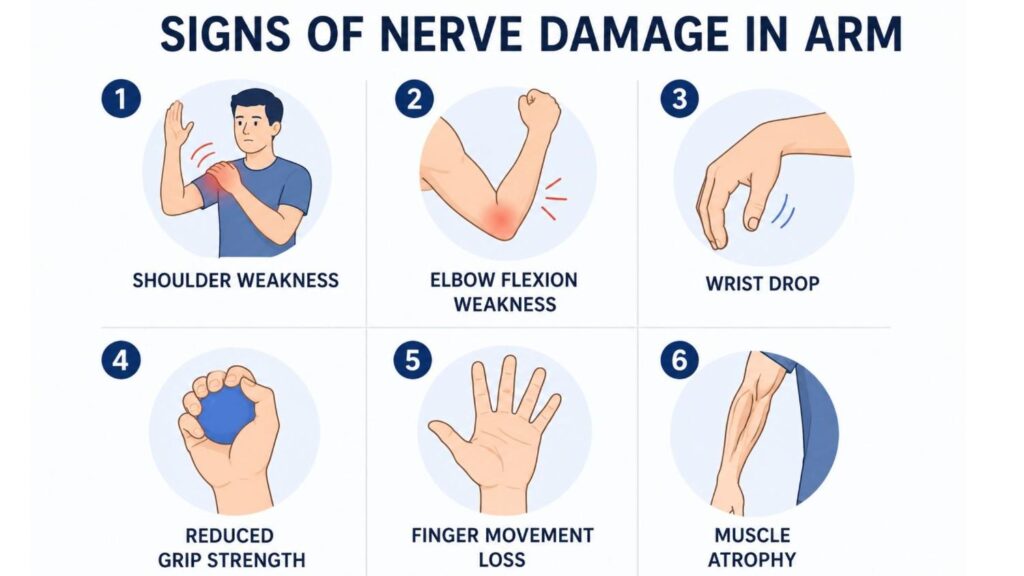
Motor signs: weakness and movement loss
Motor signs of nerve damage affect the ability to move the arm, hand, and fingers. These occur because the nerve fibres responsible for carrying signals from the brain to the muscles are damaged, reducing or eliminating the electrical commands that make muscles contract.
Understanding severity levels of nerve damage
Not all nerve damage is equal. The clinical classification of nerve injuries determines how urgently treatment is required and what type of intervention is most appropriate.
Grade 1 – Neuropraxia
Mild – full recovery likely
- Nerve is intact but temporarily blocked
- Caused by compression or minor stretch
- Weakness and numbness resolve within weeks
- No surgery typically required
Grade 2 – Axonotmesis
Moderate – recovery possible
- Internal nerve fibres damaged but sheath intact
- Caused by significant traction or crush
- Recovery slow — months to over a year
- May require surgical support
Grade 3 – Neurotmesis
Severe – surgery required
- Complete nerve rupture or avulsion
- No spontaneous recovery expected
- Requires nerve repair, graft, or transfer
- Early surgical intervention critical
Common causes of nerve damage in the arm
Nerve damage in the arm can result from traumatic injury, chronic compression, or medical conditions. Understanding the cause helps guide the appropriate treatment pathway.
Traumatic causes
- Road traffic accidents (motorcycle, car)
- Falls from height or direct impact
- Sports injuries contact or collision
- Birth-related brachial plexus injuries
- Penetrating injuries (cuts or stab wounds)
- Surgical complications or iatrogenic injury
Non-traumatic causes
- Prolonged nerve compression (cubital tunnel, carpal tunnel)
- Tumours pressing on nerve pathways
- Cervical disc herniation
- Thoracic outlet syndrome
- Diabetes-related peripheral neuropathy
- Radiation-induced nerve damage
When to see a specialist?
Not all nerve symptoms require emergency care, but certain signs indicate that prompt specialist evaluation is essential. Delaying treatment beyond the optimal window can result in permanent functional loss that could have been prevented or reduced with timely intervention.
Seek immediate specialist evaluation if you experience sudden complete loss of arm movement or sensation, especially following a trauma, accident, or forceful impact to the neck or shoulder. These are signs of a serious brachial plexus injury requiring urgent assessment.
- Arm weakness that developed suddenly or is progressively worsening over days or weeks
- Numbness or tingling that has persisted for more than a few days without improvement
- Visible muscle wasting or shrinkage in the arm, forearm, or hand
- Burning, shooting, or electric-shock pain that travels down the arm
- Inability to lift the arm, extend the wrist, or grip objects following an injury
- Any arm nerve symptoms following a road accident, sports injury, or fall even if initially mild
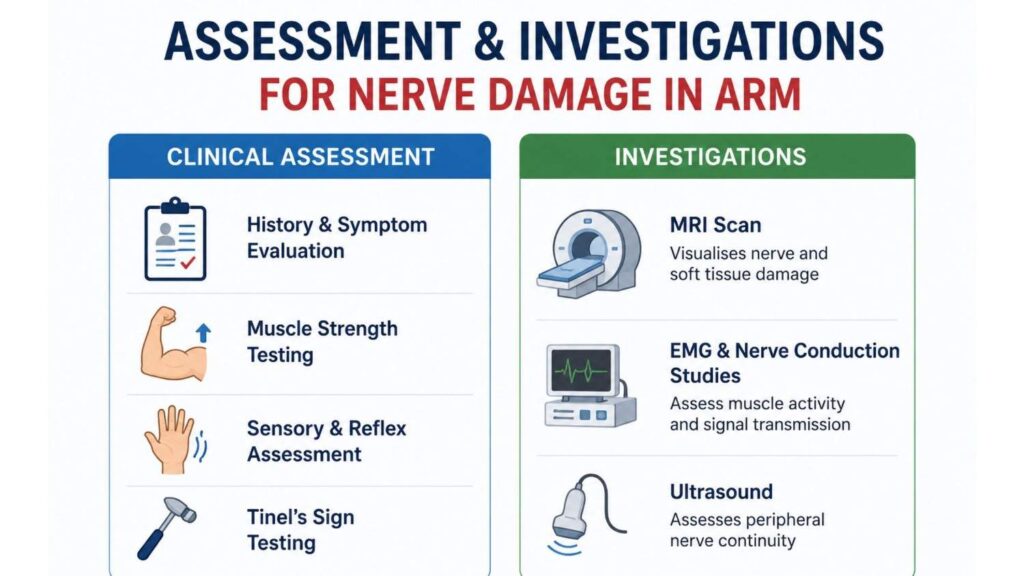
How nerve damage in the arm is diagnosed
Accurate diagnosis of arm nerve damage requires a combination of clinical examination and specialised investigations. The diagnostic process helps determine the location, severity, and type of nerve injury all of which are essential for planning effective treatment.
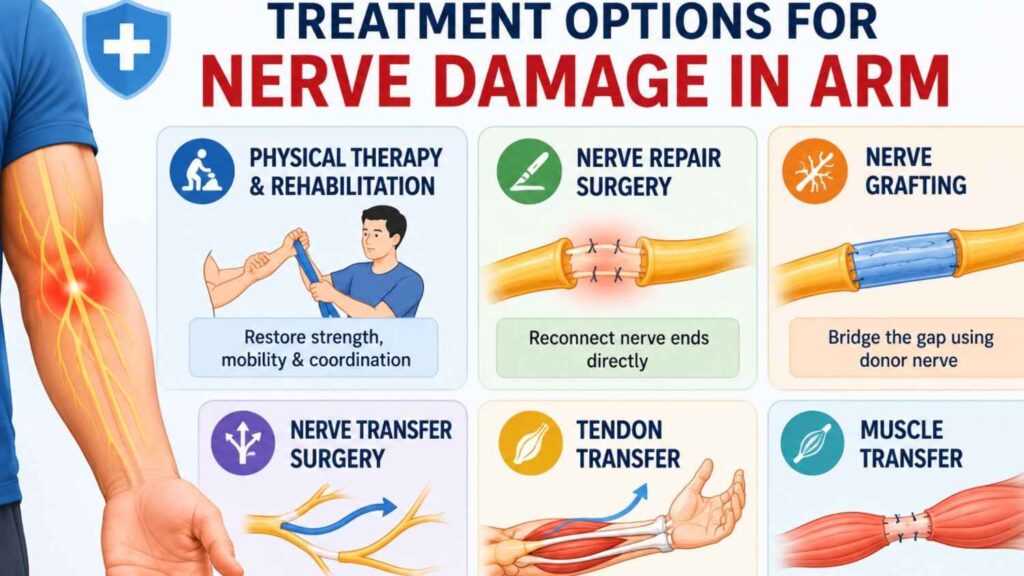
Treatment options for nerve damage in the arm
Treatment depends on the severity and cause of the nerve injury. Mild compression injuries may resolve with conservative management, while moderate to severe injuries particularly those involving the brachial plexus require specialised surgical intervention to restore function.
Early and accurate identification of nerve damage signs allows specialists to plan the most effective treatment pathway from physiotherapy and nerve repair to advanced procedures such as nerve grafting and nerve transfer surgery. For a complete breakdown of all available treatment approaches, visit our detailed guide on brachial plexus injury treatment in Kerala.
Conclusion
Recognising the signs of nerve damage in the arm at the earliest possible stage is one of the most important steps a patient or caregiver can take toward a successful recovery. Whether the damage is mild presenting as temporary tingling after a minor injury or severe, such as complete arm paralysis following a high-impact accident, timely evaluation by a specialist determines what treatment options remain available. Motor signs such as weakness, wrist drop, and muscle wasting, combined with sensory symptoms such as numbness, burning pain, and tingling, are the body’s warning signals that nerve tissue requires urgent attention. Left untreated, nerve damage can progress to permanent disability. With expert diagnosis, appropriate surgery, and structured rehabilitation, many patients with even severe arm nerve injuries achieve meaningful and life-changing recovery of function.
For authoritative information on peripheral nerve disorders and brachial plexus injuries, visit the National Institute of Neurological Disorders and Stroke (NINDS) a globally recognised resource for patients and healthcare professionals.
Frequently asked questions
1. What are the first signs of nerve damage in the arm?
The earliest signs of nerve damage in the arm are usually sensory tingling, pins and needles, or a burning sensation in the arm, forearm, or hand. Mild weakness may also appear early. These initial symptoms often follow an injury or develop gradually due to compression. Any persistent tingling or unexplained arm weakness lasting more than a few days should prompt medical evaluation.
2. Can nerve damage in the arm heal on its own?
Mild nerve injuries (neuropraxia) where the nerve is temporarily blocked but structurally intact can heal without treatment, typically within days to weeks. More significant injuries involving internal nerve fibre damage may recover slowly over months with or without surgical assistance. Severe injuries where the nerve is completely torn or avulsed from the spinal cord cannot heal without surgical intervention such as nerve grafting or nerve transfer.
3. How do I know if my arm numbness is nerve damage or something else?
Numbness caused by nerve damage tends to follow a specific anatomical pattern affecting the zones supplied by a particular nerve and is often accompanied by weakness or sensory changes. Numbness due to poor circulation tends to affect the whole hand and is relieved by movement. Numbness that is persistent, follows a dermatomal distribution, or is associated with weakness should be evaluated by a specialist rather than attributed to temporary causes.
4. Is arm weakness always a sign of nerve damage?
Not always arm weakness can also result from muscle injury, tendon tears, joint problems, or stroke. However, when weakness is accompanied by numbness, tingling, or burning pain, a nerve cause is strongly suspected. Weakness that follows a specific movement pattern for example, inability to extend the wrist (wrist drop) or raise the arm points strongly toward a specific nerve injury and warrants specialist assessment.
5. What is the difference between brachial plexus injury and general nerve damage in the arm?
General nerve damage in the arm may affect a single peripheral nerve such as the radial, median, or ulnar nerve, causing symptoms in a specific region. Brachial plexus injury affects the entire network of nerves at the root level before they divide into individual branches, often causing widespread weakness and sensory loss across the shoulder, arm, and hand simultaneously. Brachial plexus injuries are generally more complex and require specialist nerve surgery for treatment.
6. How long does it take to recover from arm nerve damage?
Recovery time depends entirely on the severity of the injury. Mild compression injuries may resolve within days to a few weeks. Moderate injuries requiring nerve regeneration typically take six months to over a year, as nerves regenerate at approximately one millimetre per day. Severe injuries requiring surgical nerve repair or grafting may take one to three years before functional recovery is assessed. Early treatment consistently leads to better and faster recovery outcomes.
7. Can physiotherapy alone treat nerve damage in the arm?
Physiotherapy is an essential component of nerve damage recovery but cannot repair a torn or avulsed nerve on its own. For mild injuries, physiotherapy helps maintain joint mobility, prevent muscle wasting, and support the natural recovery process. For moderate to severe injuries, physiotherapy works alongside surgical treatment it begins before surgery to preserve tissue health and continues after surgery to maximise functional return as nerve regeneration occurs.
8. What happens if nerve damage in the arm is left untreated?
Untreated nerve damage can lead to permanent muscle weakness or paralysis, irreversible sensory loss, chronic neuropathic pain, and progressive muscle wasting (atrophy). Once muscles have been without nerve supply for an extended period typically beyond 18 to 24 months they undergo permanent fibrotic changes that cannot be reversed even with successful nerve repair. This is why early evaluation and timely treatment are critical for the best possible outcome.
9. Which doctor should I see for signs of nerve damage in the arm?
For suspected nerve damage in the arm, particularly following trauma, you should consult a plastic and reconstructive surgeon or a peripheral nerve specialist with specific expertise in brachial plexus surgery. A general physician or orthopaedic surgeon may provide an initial assessment, but complex nerve injuries require the skills of a microsurgical nerve specialist for accurate diagnosis and treatment planning.
10. Where can I get treatment for nerve damage in the arm in Kerala?
Dr. Pradeep Kumar at the Sushrutha Institute of Plastic Surgery, Elite Mission Hospital, Thrissur, specialises in brachial plexus and peripheral nerve surgery with international training and extensive experience managing complex arm nerve injuries. For expert evaluation and treatment of nerve damage in the arm, explore our comprehensive resource on brachial plexus injury treatment in Kerala.