7 Powerful Benefits of Nerve Transfer Surgery in Kerala Now
Nerve injuries can affect the way a person moves, feels, and uses an arm or hand. When a damaged nerve cannot recover adequately on its own, nerve transfer surgery may be considered to restore useful nerve function. Nerve transfer surgery in Kerala is an advanced reconstructive treatment that redirects a healthy, functioning nerve or one of its branches to a damaged nerve pathway.
The aim is not simply to repair an injured structure. Instead, the procedure provides a new source of nerve signals to muscles that have lost their original connection. This approach can be particularly useful when direct nerve repair or nerve grafting is unlikely to provide sufficient recovery.
Understanding the causes, symptoms, surgical options, expected benefits, recovery process, and rehabilitation requirements can help patients make informed decisions about treatment.
What Is Nerve Transfer Surgery
Nerve transfer surgery is a microsurgical procedure used to restore nerve supply to muscles or areas affected by nerve damage. During the procedure, a functioning donor nerve is connected to a damaged or non-functioning nerve closer to the target muscle.
The basic principle is straightforward:
- A healthy nerve provides a source of nerve signals.
- A damaged nerve pathway is bypassed or supplemented.
- The donor nerve is connected to the affected nerve.
- Over time, nerve fibers can grow toward the target muscle.
- Rehabilitation helps the brain and muscles adapt to the new nerve pathway.
Nerve regeneration is slow, so improvement does not usually occur immediately after surgery. Recovery depends on the severity and location of the injury, the condition of the muscles, the timing of treatment, and the rehabilitation program.
Why Is Nerve Transfer Surgery Needed
Severe nerve injuries can interrupt communication between the brain, spinal cord, nerves, and muscles. If this connection remains disrupted for too long, the muscles may become weak and eventually lose their ability to respond effectively.
Nerve transfer may be considered when:
- A nerve has been severely damaged.
- A nerve has been completely disrupted.
- Direct nerve repair is not possible or is unlikely to work well.
- A nerve graft would require a long regeneration distance.
- The injury involves multiple nerves or nerve roots.
- Muscle function needs to be restored after a complex injury.
- Previous nerve treatment has not produced adequate recovery.
The decision is based on a detailed assessment rather than symptoms alone.
Common Causes of Nerve Injuries
Nerve damage can result from several types of trauma or medical conditions.
Road Traffic Accidents
High-impact accidents can stretch, compress, or tear nerves supplying the shoulder, arm, forearm, and hand. Severe traction injuries may affect several nerves at once.
Sports Injuries
Contact sports and activities involving sudden pulling or stretching of the arm can cause nerve injuries. Shoulder dislocation and severe fractures may also affect nearby nerves.
Workplace Injuries
Machinery accidents, falls, sharp injuries, and heavy lifting accidents can cause damage to peripheral nerves.
Fractures and Dislocations
Broken bones or displaced joints can compress or injure nearby nerves. In some cases, nerve damage becomes apparent after the initial injury.
Surgical or Treatment-Related Injury
Although uncommon, nerves can sometimes be affected during surgical procedures. Treatment depends on the nature and severity of the injury.
Birth-Related Nerve Injuries
Some infants can experience nerve injuries involving the shoulder and arm during difficult deliveries. Early assessment is important because treatment requirements can differ significantly in children.
Types of Nerve Transfer Procedures
The specific procedure depends on which nerve has been damaged and which muscles need to regain function.
Motor Nerve Transfers
Motor nerve transfers are designed to restore movement. A functioning donor nerve is connected to a damaged nerve supplying a muscle that has become weak or paralyzed.
The goal may be to improve:
- Shoulder movement
- Elbow bending
- Elbow straightening
- Wrist movement
- Finger movement
- Thumb function
Sensory Nerve Transfers
Sensory nerve transfers can be considered when the objective is to improve sensation in an area affected by nerve damage.
Depending on the injury, treatment may aim to improve protective sensation, touch perception, or other forms of sensory function.
Brachial Plexus Nerve Transfers
The brachial plexus is a network of nerves responsible for movement and sensation in much of the upper limb. Severe brachial plexus injuries can affect several functions simultaneously.
Nerve transfer techniques may be used to target specific lost functions based on the pattern of injury.
Distal Nerve Transfers
A distal transfer connects the donor nerve relatively close to the target muscle. Because the distance for nerve regeneration is shorter, this approach can sometimes provide an advantage when appropriately selected.
Symptoms That May Indicate Significant Nerve Damage
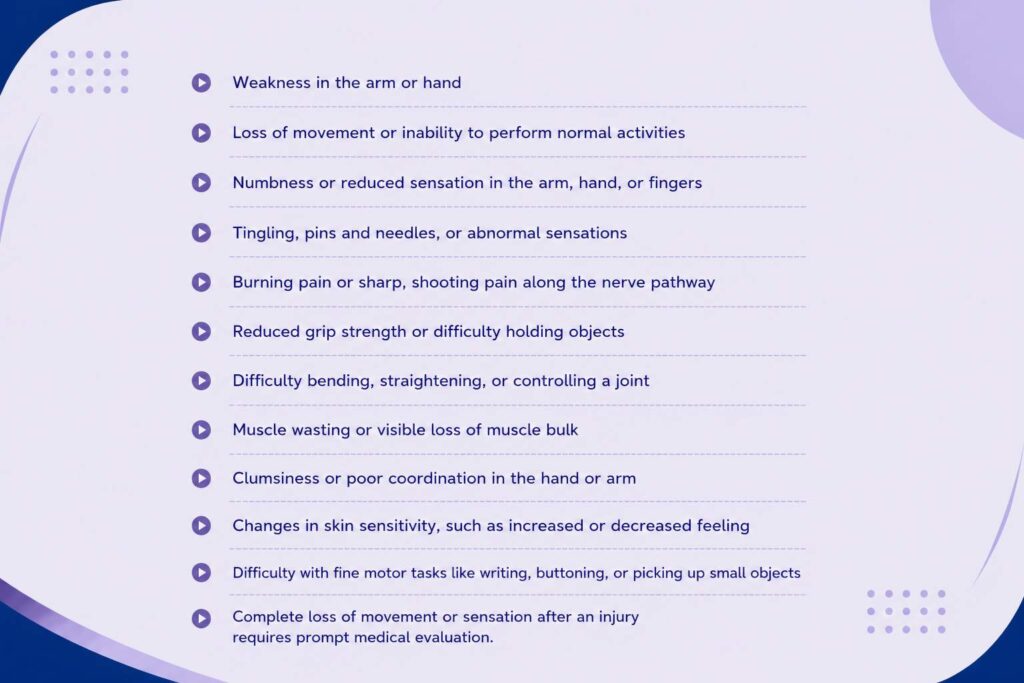
Symptoms vary depending on the nerve involved and the severity of the injury.
Common signs include:
- Weakness in the arm or hand
- Loss of movement
- Numbness
- Tingling or abnormal sensations
- Burning or shooting pain
- Reduced grip strength
- Difficulty bending or straightening a joint
- Muscle wasting
- Reduced coordination
- Changes in skin sensation
- Difficulty performing everyday activities
A complete loss of movement after a significant injury requires timely specialist evaluation. Delaying assessment can affect treatment options because muscles may become less responsive when they remain without adequate nerve supply for an extended period.
Nerve Transfer Surgery in Kerala: How Treatment Is Planned
Treatment planning is highly individualized. There is no single nerve transfer procedure suitable for every patient.
The treatment team considers:
- The exact location of the injury
- Type and severity of nerve damage
- Time since the injury
- Available healthy donor nerves
- Condition of the affected muscles
- Existing movement and sensation
- Results of nerve and muscle testing
- Previous operations
- Overall functional goals
The objective is to choose a donor nerve that can provide useful function without causing unacceptable loss of its original function.
Benefits of Nerve Transfer Surgery
When appropriately selected, nerve transfer can offer several potential benefits.
1. Restoration of Useful Movement
One of the primary goals is to restore movement in a previously weak or paralyzed muscle.
2. Shorter Nerve Regeneration Distance
A transfer can place the functioning nerve closer to the target muscle. This may reduce the distance nerve fibers need to travel during regeneration.
3. Bypass of a Severely Damaged Nerve Segment
If a portion of the original nerve is badly damaged, transferring a healthy nerve can bypass the problematic section.
4. Potential Improvement in Arm Function
Restoring one important movement can make everyday activities easier. For example, improved elbow movement can assist with positioning the hand for daily tasks.
5. Targeted Reconstruction
Different transfers can be selected for different functional goals, allowing treatment to focus on movements that are particularly important to the patient.
6. Possibility of Functional Recovery After Severe Injury
Some injuries that initially appear to have limited options may be suitable for reconstructive nerve procedures.
7. Support for Long-Term Rehabilitation
Surgery provides a new nerve pathway, while rehabilitation helps train the brain and muscles to use that pathway effectively.
Treatment Options Besides Nerve Transfer
Nerve transfer is only one part of the broader treatment spectrum for nerve injuries.
Depending on the injury, treatment may include:
- Observation and monitoring
- Physiotherapy
- Occupational therapy
- Pain management
- Direct nerve repair
- Nerve grafting
- Tendon transfer
- Muscle transfer
- Joint procedures
- Reconstructive surgery
The most suitable option depends on the timing, anatomy, severity, and functional goals associated with the injury.
What Happens During Nerve Transfer Surgery
The procedure is generally performed using microsurgical techniques. The surgeon identifies an appropriate functioning donor nerve and the damaged nerve that needs new nerve input.
The main steps may include:
- Identifying the injured nerve pathway.
- Locating an appropriate donor nerve.
- Preparing the donor and recipient nerve ends.
- Connecting the nerves using microsurgical techniques.
- Protecting the repair and surrounding tissues.
- Closing the surgical area appropriately.
The exact surgical approach varies according to the nerves involved.
Recovery After Nerve Transfer Surgery
Recovery is a gradual process. Nerves regenerate slowly, and functional improvement may take months or longer.
Initially, the focus may be on protecting the surgical repair and maintaining appropriate joint and muscle flexibility. As healing progresses, rehabilitation becomes increasingly important.
Patients may need:
- Physiotherapy
- Occupational therapy
- Muscle-strengthening exercises
- Range-of-motion exercises
- Sensory retraining
- Movement re-education
- Functional training
The rehabilitation plan should be followed consistently because the brain may need to learn how to use the new nerve pathway.
What Factors Affect Recovery
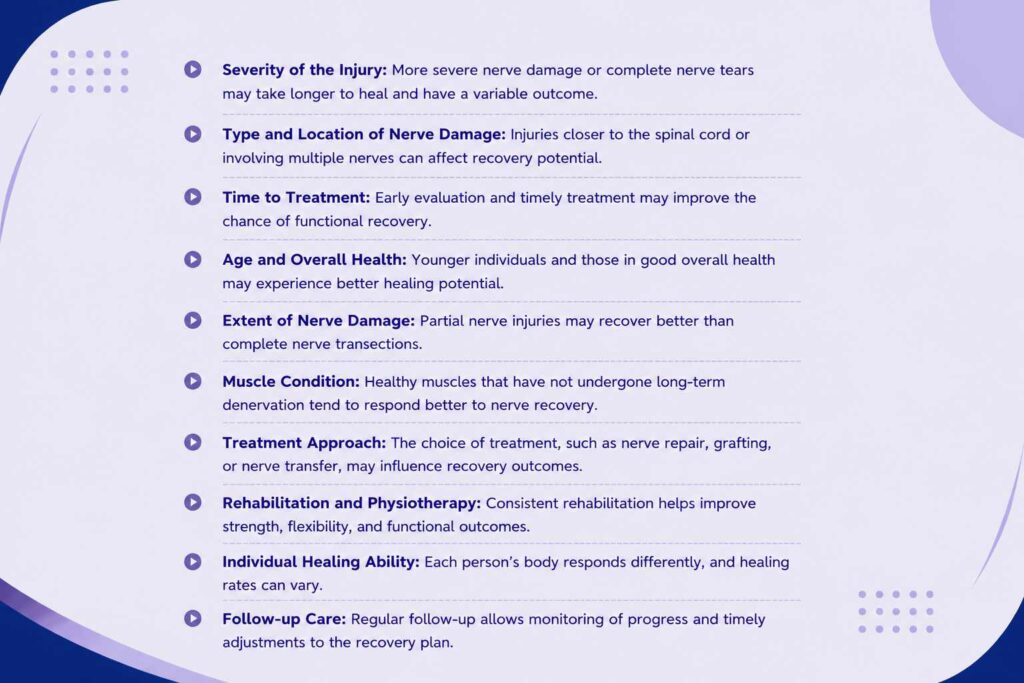
Recovery differs from person to person. Several factors can influence the outcome.
Timing of Treatment
Earlier assessment can help identify suitable reconstructive options before irreversible muscle changes occur.
Severity of Injury
A partial nerve injury may behave differently from a complete nerve disruption.
Muscle Condition
Healthy, responsive muscles generally provide a better target for reinnervation than severely wasted muscles.
Patient Age and General Condition
Age and overall physical condition can influence healing and rehabilitation capacity.
Rehabilitation
Consistent rehabilitation is a major component of functional recovery.
Type of Nerve Transfer
Different transfers have different objectives and expected recovery patterns.
Possible Risks and Limitations
As with any surgical procedure, nerve transfer surgery has potential risks. These may include infection, bleeding, scarring, pain, incomplete recovery, weakness in the donor nerve function, or failure to achieve the expected improvement.
Recovery is also not guaranteed. Nerve regeneration takes time, and the final result can vary considerably.
Patients should discuss:
- Expected functional improvement
- Possible complications
- Donor nerve effects
- Recovery timeline
- Rehabilitation requirements
- Alternative treatment options
- Long-term expectations
Understanding realistic outcomes is an important part of surgical planning.
Tips for Better Recovery
Following the rehabilitation plan carefully can support recovery.
Protect the Surgical Area
Follow instructions regarding movement restrictions, wound care, and activity levels.
Attend Follow-Up Appointments
Regular assessments allow progress to be monitored and rehabilitation to be adjusted.
Stay Consistent With Therapy
Nerve recovery is gradual. Consistent exercises are generally more useful than irregular intensive sessions.
Avoid Smoking
Smoking can negatively affect healing and overall tissue health. Avoiding tobacco products can support recovery.
Maintain a Balanced Diet
Adequate protein, vitamins, minerals, and overall nutrition support normal tissue repair.
Be Patient
Functional nerve recovery is measured over months rather than days. Lack of immediate movement does not necessarily mean treatment has failed.
When Should You Seek an Evaluation
An evaluation should be considered after a significant injury involving persistent weakness, numbness, loss of movement, or severe nerve-related pain.
Early assessment is particularly important when:
- Movement is completely absent.
- Weakness continues after an injury.
- There is progressive muscle wasting.
- Sensation is significantly reduced.
- A fracture or dislocation was associated with nerve symptoms.
- An injury involved severe stretching or traction.
- Recovery has stopped progressing.
Prompt assessment helps establish whether further observation or reconstructive treatment is appropriate.
Conclusion
Nerve injuries can have a major effect on independence and quality of life, particularly when they interfere with arm and hand movement. Nerve transfer surgery in Kerala can provide a reconstructive option for selected patients by creating a new pathway for nerve signals to reach affected muscles.
A successful treatment plan involves more than surgery. Accurate diagnosis, appropriate procedure selection, realistic expectations, careful follow-up, and consistent rehabilitation all contribute to the recovery process. Anyone experiencing significant weakness, numbness, or loss of movement after a nerve injury should seek timely evaluation to understand the available treatment options. For trusted information about nerve injury diagnosis, nerve repair, nerve grafting, and nerve transfer procedures, visit Mayo Clinic – Peripheral Nerve Injuries: Diagnosis and Treatment.
Frequently Asked Questions
What is nerve transfer surgery?
Who may need nerve transfer surgery?
Is nerve transfer surgery better than nerve grafting?
When is nerve transfer surgery considered?
Can nerve transfer surgery restore arm and hand movement?
How long does nerve recovery take after surgery?
Is physiotherapy necessary after nerve transfer surgery?
Does nerve transfer surgery require a donor nerve?
What tests are performed before nerve transfer surgery?
Does timing matter for nerve transfer surgery?

Dr. Pradeep Kumar
Plastic & Reconstructive Surgeon – Brachial Plexus & Nerve Surgery Specialist
Dr. Pradeep Kumar is an experienced plastic and reconstructive surgeon known for his expertise in brachial plexus and peripheral nerve surgery. With extensive microsurgical experience, he focuses on restoring movement and function for patients with complex nerve injuries.
Sushrutha Institute of Plastic Surgery, Elite Mission Hospital, Thrissur