7 Powerful Erb's Palsy Treatment in Kerala: Complete Guide
Erb’s palsy is a nerve-related condition that can affect movement, strength, and function in the shoulder, arm, and hand. Understanding the available Erb’s Palsy Treatment in Kerala can help patients and families make informed decisions about evaluation, rehabilitation, and, when necessary, surgical care. Treatment depends on the severity of the nerve injury, the patient’s age, the muscles affected, and how much natural recovery occurs over time.
Early assessment is important because nerve injuries can change gradually. Some patients improve with observation and physiotherapy, while others may need specialized procedures to restore useful movement. The goal of Erb’s Palsy Treatment in Kerala is not simply to improve strength but to maximize functional movement and independence.
What Is Erb’s Palsy
Erb’s palsy is a type of brachial plexus injury involving nerves that control movement and sensation in parts of the upper limb. The brachial plexus is a network of nerves extending from the neck toward the shoulder, arm, and hand.
When these nerves are stretched, compressed, or damaged, signals between the brain and affected muscles may become weak or interrupted. This can result in difficulty moving the shoulder, elbow, wrist, or fingers.
The condition is particularly recognized in newborns following difficult childbirth, but similar nerve injuries can also occur because of trauma later in life.
The severity can range from temporary nerve dysfunction to significant nerve damage requiring surgical reconstruction.
Causes of Erb’s Palsy
Erb’s palsy may develop when the upper portion of the brachial plexus is injured. The cause can influence both the severity of symptoms and the treatment approach.
Birth-Related Causes
In infants, Erb’s palsy may occur when excessive force or stretching affects the baby’s shoulder and neck during delivery.
Possible contributing factors include:
- Difficult or prolonged delivery
- Shoulder dystocia
- Large birth weight
- Assisted delivery
- Abnormal positioning during birth
- Excessive stretching of the baby’s neck and shoulder
Not every birth-related brachial plexus injury has the same cause, and some cases occur despite appropriate medical care.
Traumatic Causes in Older Children and Adults
Erb’s palsy can also result from injuries affecting the shoulder and neck region.
Potential causes include:
- Road traffic accidents
- Sports injuries
- Falls
- Shoulder trauma
- Severe traction injuries
- Certain surgical or medical complications
A detailed assessment is necessary to determine which nerves are affected and how severely they have been damaged.
Types of Nerve Injury in Erb’s Palsy
The type of nerve damage is an important factor when planning Erb’s Palsy Treatment in Kerala.
Neuropraxia
Neuropraxia is generally considered a milder form of nerve injury. The nerve remains structurally intact but does not transmit signals normally for a period of time.
Many cases can improve naturally, particularly when the underlying nerve structure has not been seriously disrupted.
Axonotmesis
In axonotmesis, the nerve’s internal fibers are damaged while some of the surrounding structures remain preserved. Recovery can occur, but it may take considerable time.
Physiotherapy and careful monitoring can be important while the nerve heals.
Neurotmesis
Neurotmesis involves severe disruption of the nerve. Spontaneous recovery may be limited, and surgical reconstruction can become necessary depending on the location and extent of the injury.
Nerve Root Avulsion
A nerve root avulsion is a severe injury in which a nerve root is pulled away from the spinal cord. This type of injury is generally more complex and may require specialized nerve reconstruction procedures.
Symptoms of Erb’s Palsy
Symptoms vary according to the nerves involved and the severity of the injury.
Common signs may include:
- Weakness in the affected arm
- Reduced shoulder movement
- Difficulty bending the elbow
- Limited ability to rotate the forearm
- Reduced hand or finger function in more extensive injuries
- Altered sensation
- Muscle weakness or reduced muscle development
- An abnormal resting position of the arm
- Difficulty reaching overhead
- Problems with everyday activities
In infants, parents may notice that one arm moves less than the other. The affected arm may remain close to the body, with limited movement at the shoulder or elbow.
Any persistent difference in movement between the two arms should be assessed by an appropriate healthcare professional.
How Is Erb’s Palsy Diagnosed
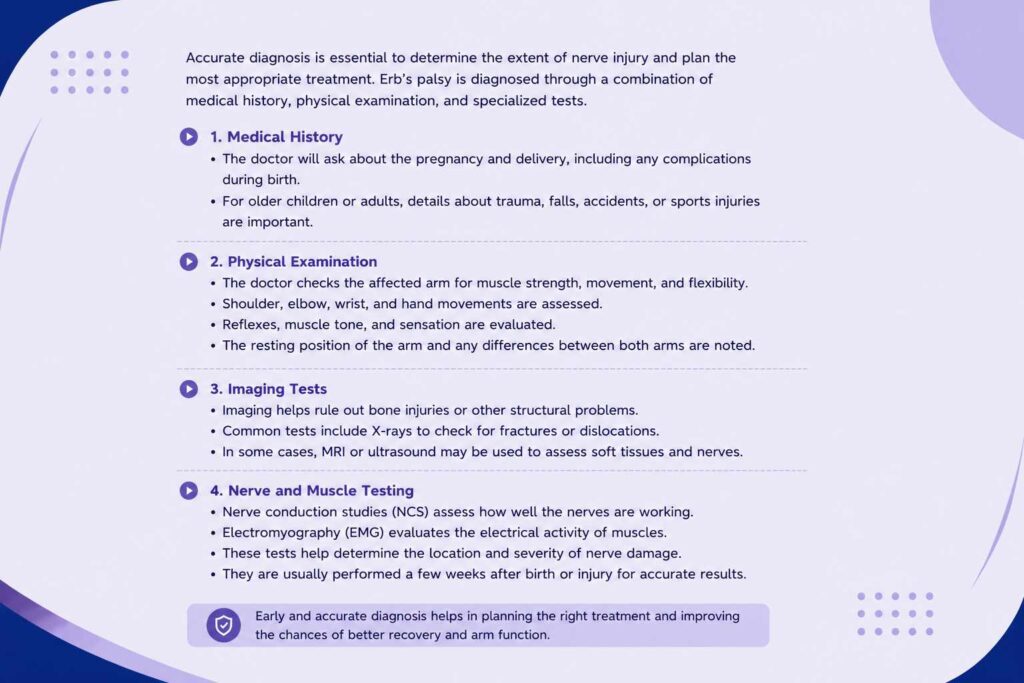
An accurate diagnosis is essential before selecting Erb’s Palsy Treatment in Kerala. Evaluation usually begins with a medical history and physical examination.
The assessment may include:
Physical Examination
The healthcare professional evaluates:
- Muscle strength
- Range of motion
- Reflexes
- Sensation
- Shoulder movement
- Elbow movement
- Wrist and hand function
- Muscle development
- Functional ability
In children, age-appropriate movement and developmental milestones are also considered.
Imaging Tests
Depending on the suspected injury, imaging may help assess associated structural problems or nerve-related abnormalities.
Tests may include:
- Ultrasound in selected situations
- X-rays
- MRI
- Other specialized imaging studies
Nerve and Muscle Testing
Electrodiagnostic tests may sometimes be used to assess nerve and muscle function. These tests can provide additional information about the location and severity of nerve dysfunction.
The combination of clinical examination and appropriate investigations helps establish a treatment plan.
7 Powerful Erb’s Palsy Treatment Options
The best Erb’s Palsy Treatment in Kerala depends on the individual case. There is no single treatment suitable for every patient.
1. Observation and Regular Assessment
Some nerve injuries improve naturally. When recovery is expected, healthcare professionals may monitor movement and muscle function over time.
Regular assessments can help determine whether recovery is progressing appropriately.
Observation does not mean ignoring the condition. Follow-up allows changes in strength, range of motion, and functional ability to be identified.
2. Physiotherapy
Physiotherapy is an important part of Erb’s Palsy Treatment in Kerala, particularly during recovery and after surgical procedures.
A rehabilitation program may focus on:
- Maintaining joint flexibility
- Preventing stiffness
- Improving muscle strength
- Encouraging appropriate movement
- Supporting motor development
- Improving coordination
- Protecting the affected joints
Exercises should be appropriate for the patient’s age, condition, and stage of recovery.
3. Occupational Therapy
Occupational therapy focuses on practical activities and functional independence.
For children, therapy may support age-appropriate activities such as reaching, grasping, dressing, playing, and using both arms together.
For adults, occupational therapy may help with daily tasks, workplace activities, and adaptation to changes in upper-limb function.
4. Nerve Grafting
When a nerve has been significantly damaged and cannot recover adequately on its own, nerve grafting may be considered.
During nerve grafting, a segment of nerve tissue is used to bridge a damaged section. The objective is to provide a pathway through which nerve fibers can regenerate toward the target muscles.
Nerve regeneration is slow, so recovery after reconstruction may take months or longer.
5. Nerve Transfer
Nerve transfer surgery may be considered in selected severe injuries.
A functioning nerve or a suitable branch of a nerve can be redirected toward a damaged nerve or muscle target. The aim is to restore useful nerve signals to muscles that have lost their normal nerve supply.
The suitability of nerve transfer depends on factors such as the injury pattern, timing, available donor nerves, and muscle condition.
6. Muscle and Tendon Procedures
If nerve recovery does not provide sufficient function, additional procedures may sometimes be considered.
Muscle or tendon procedures can help improve specific movements by changing the mechanics of functioning muscles.
These procedures are usually considered according to the individual’s remaining muscle function and functional goals.
7. Long-Term Rehabilitation and Support
Recovery from a brachial plexus injury may extend over a long period. Continued rehabilitation can help patients make the most of recovered movement.
Long-term care may involve:
- Physiotherapy
- Occupational therapy
- Home exercises
- Functional training
- Regular clinical reviews
- Monitoring of joint movement
- Management of muscle imbalance
A structured rehabilitation plan is particularly important when treatment involves surgery.
Benefits of Early Erb’s Palsy Treatment
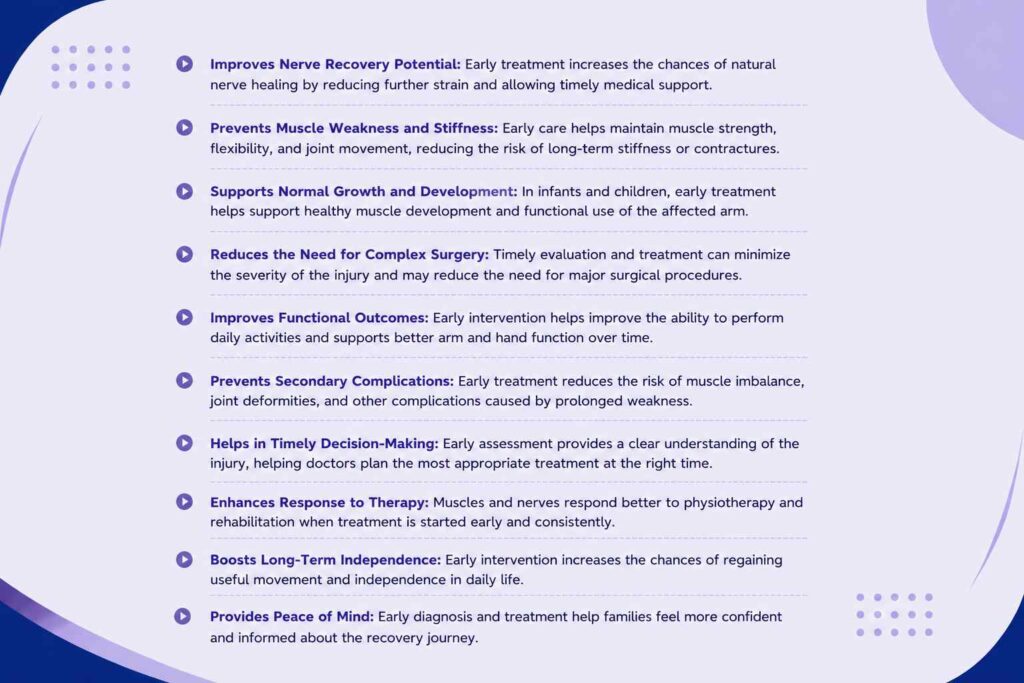
Seeking assessment at an appropriate stage can provide several advantages.
Potential benefits include:
- Identifying the extent of nerve injury
- Monitoring natural nerve recovery
- Maintaining joint mobility
- Reducing the risk of contractures
- Supporting muscle development
- Improving functional movement
- Identifying patients who may benefit from surgery
- Supporting long-term independence
Early evaluation does not automatically mean surgery. Instead, it provides an opportunity to understand the injury and choose an appropriate management strategy.
When May Surgery Be Considered
Surgery may be considered when there is evidence of significant nerve damage or insufficient recovery within an appropriate observation period.
Factors that may influence the decision include:
- Severity of nerve injury
- Pattern of muscle weakness
- Evidence of spontaneous recovery
- Age of the patient
- Time since injury
- Results of clinical assessments
- Imaging or electrodiagnostic findings
- Functional limitations
The timing of surgery is important because muscles can become less responsive when they remain without adequate nerve supply for a prolonged period.
However, surgery is not appropriate for every patient. The decision should be based on an individualized assessment.
What to Expect During Recovery
Recovery from Erb’s palsy can be gradual. Nerves regenerate slowly, and improvements may become noticeable over an extended period.
Patients and families should understand that:
- Recovery may take months or longer.
- Movement may return gradually rather than suddenly.
- Rehabilitation is often an important part of treatment.
- Strength and coordination may improve at different rates.
- Regular follow-up helps track progress.
- Functional improvement can continue after the initial treatment period.
After surgery, rehabilitation may be particularly important to help the brain and muscles adapt to newly restored nerve signals.
Tips for Supporting Recovery
Patients and caregivers can support recovery by following the recommended treatment and rehabilitation plan consistently.
Useful practices include:
- Attend scheduled follow-up appointments.
- Perform prescribed exercises correctly.
- Avoid forcing painful movements.
- Encourage safe use of the affected arm.
- Follow postoperative instructions carefully when surgery is performed.
- Monitor changes in movement and strength.
- Discuss new symptoms with the treating healthcare professional.
- Maintain realistic expectations about nerve recovery.
For children, making exercises engaging and age-appropriate can make rehabilitation easier to maintain.
Why Individualized Treatment Matters
No two brachial plexus injuries are exactly alike. Two people may have similar-looking weakness but very different underlying nerve damage.
For this reason, Erb’s Palsy Treatment in Kerala should be based on the individual’s condition rather than a standard treatment formula.
Important considerations include the nerves involved, severity of injury, age, muscle function, duration of the condition, and response to previous treatment.
A treatment plan may also change over time as new recovery becomes apparent.
Can Erb’s Palsy Improve Without Surgery
Yes, some cases can improve without surgery, particularly when the nerve injury is less severe and spontaneous recovery occurs.
However, the extent of recovery varies. Continued weakness, limited movement, or abnormal muscle development may indicate a need for further evaluation.
Regular monitoring is therefore important even when initial management involves observation and therapy.
Can Adults Have Erb’s Palsy
Yes. Although the condition is commonly associated with birth-related brachial plexus injuries, adults can develop similar upper brachial plexus injuries following significant trauma.
The symptoms may include shoulder weakness, difficulty bending the elbow, altered sensation, and problems using the affected arm.
Treatment depends on the injury pattern and the extent of nerve damage.
Conclusion
Erb’s palsy can affect movement and function in ways that vary considerably from one person to another. Understanding the condition early can help patients and families recognize the importance of assessment, monitoring, rehabilitation, and timely intervention when required.
Erb’s Palsy Treatment in Kerala may include observation, physiotherapy, occupational therapy, nerve reconstruction, nerve grafting, nerve transfer, or other procedures depending on the severity and pattern of injury. The most appropriate approach should always be individualized.
With proper assessment and a structured treatment and rehabilitation plan, many patients can work toward better movement, strength, and functional independence. If persistent weakness or restricted arm movement is present, appropriate specialist evaluation can help determine the next step. You can learn more about Erb’s palsy and brachial plexus injuries from the National Institute of Neurological Disorders and Stroke (NINDS).
Frequently Asked Questions
What is Erb's palsy?
What are the common symptoms of Erb's palsy?
Can Erb's palsy recover without surgery?
When is surgery considered for Erb's palsy?
What treatments are available for Erb's palsy?
Is physiotherapy necessary for Erb's palsy?
Can nerve grafting be used to treat Erb's palsy?
Can nerve transfer help restore arm movement?
How long does recovery from Erb's palsy take?
Does early treatment matter for Erb's palsy?
Dr. Pradeep Kumar
Plastic & Reconstructive Surgeon – Brachial Plexus & Nerve Surgery Specialist
Dr. Pradeep Kumar is an experienced plastic and reconstructive surgeon known for his expertise in brachial plexus and peripheral nerve surgery. With extensive microsurgical experience, he focuses on restoring movement and function for patients with complex nerve injuries.
Sushrutha Institute of Plastic Surgery, Elite Mission Hospital, Thrissur