Who Needs Brachial Plexus Surgery? Signs, Conditions and Treatment Criteria
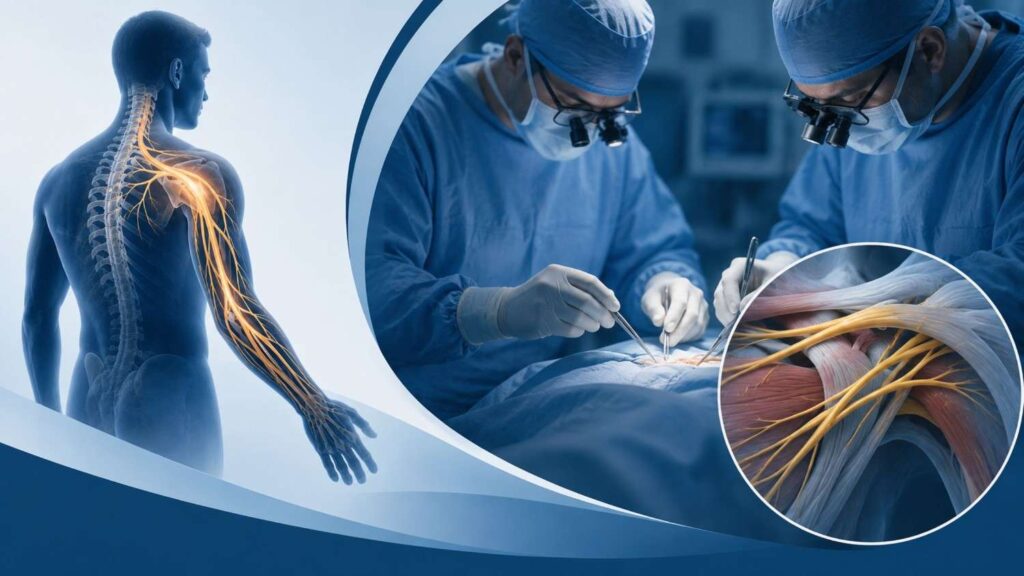
A brachial plexus injury can range from a temporary nerve stretch that improves with time to a severe nerve rupture or avulsion that causes lasting weakness, loss of sensation, or paralysis. Because the severity of nerve damage varies significantly, not every person with a brachial plexus injury needs an operation. Understanding who needs brachial plexus surgery is therefore an important part of making an informed treatment decision. For a broader overview of brachial plexus conditions, treatment options, surgery, and recovery, read our guide to a Brachial Plexus Surgery Doctor in Kerala.
Brachial plexus surgery may be considered when damaged nerves are unlikely to recover adequately on their own, when there is significant loss of arm or hand function, or when diagnostic tests indicate a severe nerve injury. The timing of treatment can also be important because muscles can gradually lose their ability to respond when they remain without normal nerve supply for a prolonged period.
Understanding Who Needs Brachial Plexus Surgery
The brachial plexus is a network of nerves that begins near the neck and carries signals between the spinal cord and the shoulder, arm, and hand. These nerves are responsible for important motor and sensory functions, including movement, strength, and feeling in the upper limb.
When these nerves are stretched, compressed, bruised, torn, or pulled away from the spinal cord, the resulting injury can affect different parts of the arm. A mild injury may recover naturally, while a severe injury may require reconstruction.
So, who needs brachial plexus surgery?
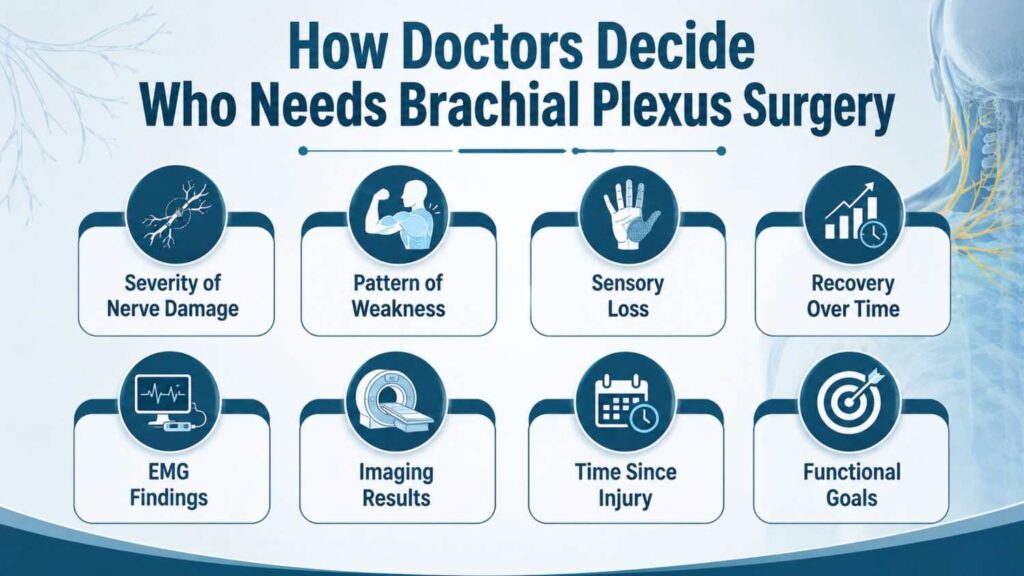
In general, surgery is considered for people whose nerve damage is severe enough that spontaneous recovery is unlikely, whose function remains significantly impaired despite appropriate observation or rehabilitation, or whose injury pattern requires early surgical reconstruction. The decision should be based on the location and severity of the injury, the patient’s age, functional goals, diagnostic findings, and the condition of the affected muscles and nerves.
Who Needs Brachial Plexus Surgery After a Severe Accident?
High-energy trauma is one of the major causes of serious brachial plexus injuries. Motorcycle crashes, vehicle accidents, falls, sports injuries, and other forms of major trauma can place intense traction on the nerves connecting the neck and upper limb.
A person may need surgical assessment after an accident if they develop:
- Sudden loss of arm movement
- Severe shoulder weakness
- Loss of elbow movement
- Loss of hand or finger movement
- Significant numbness
- Severe or persistent nerve pain
- An arm that hangs without normal control
- Major loss of grip strength
- Progressive muscle wasting
- Persistent weakness that does not improve
A severe traumatic injury may involve nerve rupture or avulsion. In an avulsion, the nerve root is pulled away from the spinal cord, making direct repair difficult or impossible. Such injuries may require reconstructive procedures such as nerve transfers or other methods of restoring useful function.
Therefore, people who develop major neurological deficits after significant trauma should receive specialist evaluation rather than assuming that the symptoms will resolve on their own.
Who Needs Brachial Plexus Surgery for Nerve Rupture?
A nerve rupture occurs when the nerve is torn but remains connected to the surrounding structures rather than being pulled completely away from the spinal cord.
Depending on the location and extent of the rupture, the nerve may sometimes be repaired directly. If there is a damaged segment or a gap between the healthy nerve ends, nerve grafting may be considered.
This is one important group when asking who needs brachial plexus surgery.
Surgery may be considered when:
- The nerve has been completely torn.
- The damaged section cannot recover normally.
- There is a significant gap between healthy nerve ends.
- Scar tissue prevents normal nerve signal transmission.
- Functional recovery is unlikely without reconstruction.
Nerve repair reconnects viable nerve ends, while nerve grafting can bridge a damaged section when direct reconnection is not possible.
Who Needs Brachial Plexus Surgery for Nerve Avulsion?
Nerve avulsion represents a particularly severe form of brachial plexus injury. It occurs when a nerve root is pulled away from the spinal cord.
Because the affected nerve root is no longer normally connected to the spinal cord, conventional direct nerve repair may not be possible. In selected cases, nerve transfer surgery can provide an alternative route for nerve signals to reach muscles that have lost their normal nerve supply.
This makes patients with confirmed or strongly suspected nerve avulsion an important category when considering who needs brachial plexus surgery.
Nerve transfers involve connecting a functioning donor nerve to an injured nerve or its target pathway. The specific transfer depends on which movements have been lost and which functioning nerves are available.
Who Needs Brachial Plexus Surgery When the Arm Is Paralyzed?
Paralysis or near-complete loss of movement in the arm is a major warning sign following a traumatic injury.
A completely or severely paralyzed arm may indicate extensive damage involving multiple components of the brachial plexus. The injury may affect the shoulder, elbow, wrist, hand, or several of these areas at the same time.
Not every case of weakness means surgery is immediately necessary. However, persistent paralysis following significant trauma requires careful evaluation to determine whether the nerves are recovering.
If diagnostic findings show that meaningful spontaneous recovery is unlikely, reconstructive surgery may become necessary.
Therefore, who needs brachial plexus surgery can include people with persistent paralysis when the underlying nerve injury is severe and unlikely to recover without intervention.
Who Needs Brachial Plexus Surgery When Weakness Does Not Improve?
Some brachial plexus injuries are temporary. A stretched or mildly injured nerve may gradually recover over weeks or months.
However, lack of improvement can become concerning when weakness persists and there is little evidence of nerve regeneration.
Doctors may monitor recovery through:
- Physical examinations
- Muscle strength testing
- Sensory testing
- Electromyography
- Nerve conduction studies
- MRI
- CT or CT myelography when appropriate
- Other specialized imaging or nerve assessments
These investigations help determine whether the nerve is recovering and whether the affected muscles are still capable of responding to nerve reconstruction.
When meaningful recovery does not occur within the expected period, surgical reconstruction may be considered.
Who Needs Brachial Plexus Surgery After Failed Conservative Treatment?
Not every brachial plexus injury requires surgery.
Milder injuries may be managed with:
- Physiotherapy
- Occupational therapy
- Pain management
- Splinting
- Range-of-motion exercises
- Muscle strengthening
- Functional rehabilitation
- Regular clinical monitoring
If these measures are appropriate and the nerve demonstrates progressive recovery, surgery may not be necessary.
However, if a patient continues to experience significant weakness, paralysis, functional limitations, or persistent symptoms despite appropriate observation and rehabilitation, further surgical assessment may be necessary.
This is another important answer to who needs brachial plexus surgery: patients whose injury is not demonstrating adequate recovery and whose remaining functional impairment is significant.
Who Needs Brachial Plexus Surgery Based on EMG and Nerve Tests?
Electromyography and nerve conduction studies can provide important information about nerve and muscle function.
These tests can help clinicians understand:
- Whether the nerve is transmitting signals
- Which muscles are affected
- Whether nerve regeneration is occurring
- How severe the nerve damage may be
- Whether the affected muscles remain responsive
- Whether other nerves may be suitable for nerve transfer
EMG findings are not interpreted in isolation. They are considered alongside the patient’s symptoms, physical examination, injury history, imaging, and progression over time.
Consequently, who needs brachial plexus surgery cannot be determined simply from one test result. A complete assessment is necessary to understand whether surgery is likely to provide meaningful functional benefit.
Who Needs Brachial Plexus Surgery Based on MRI or CT Findings?
Imaging can help identify structural abnormalities affecting the brachial plexus and surrounding tissues.
MRI may provide information about damaged nerves and soft tissues, while CT and CT myelography can help evaluate particular structural injuries, including suspected nerve root avulsion in appropriate cases.
Imaging findings can therefore contribute to identifying who needs brachial plexus surgery.
However, imaging alone does not automatically mean that an operation is required. The findings must be interpreted together with the patient’s functional status, neurological examination, age, injury mechanism, and expected potential for recovery.
Who Needs Brachial Plexus Surgery for Persistent Nerve Pain?
Severe brachial plexus injuries can produce intense neuropathic pain. Patients may describe the pain as burning, stabbing, crushing, electric, or persistent.
Pain does not automatically mean that surgery is required. Some patients can manage symptoms with appropriate medical treatment and rehabilitation.
However, severe persistent pain associated with major nerve damage may require specialist evaluation, particularly when conventional treatment does not provide adequate relief.
In selected cases, surgical procedures may be considered as part of a broader treatment strategy. The exact approach depends on the underlying cause and location of the nerve injury.
This means that who needs brachial plexus surgery may include selected patients whose pain is associated with severe structural nerve injury and significant functional impairment.
Who Needs Brachial Plexus Surgery for Muscle Wasting?
Muscles depend on functioning nerves for normal activation. When nerve supply is lost for a prolonged period, affected muscles can become weak and gradually shrink.
Visible muscle wasting may therefore indicate a significant or longstanding nerve injury.
Muscle wasting does not by itself prove that surgery will be successful or necessary. However, it is an important clinical finding that should prompt appropriate assessment.
In patients with longstanding injuries, conventional nerve reconstruction may not always be sufficient. Depending on the circumstances, procedures such as tendon transfer or functional muscle transfer may be considered to restore specific movements.
Who Needs Brachial Plexus Surgery for Nerve Tumors?
Brachial plexus problems are not limited to traumatic injuries.
Some patients develop tumors involving the brachial plexus, including nerve sheath tumors such as schwannomas or neurofibromas. Treatment depends on the type, size, location, symptoms, and behavior of the tumor.
Surgery may be considered when a tumor causes significant symptoms, grows in a concerning manner, or requires removal for diagnostic or therapeutic reasons.
This represents another, less common group when considering who needs brachial plexus surgery.
Who Needs Brachial Plexus Surgery After a Penetrating Injury?
Sharp or penetrating trauma can directly damage nerves.
Examples may include injuries caused by:
- Sharp objects
- Machinery
- Glass
- Other penetrating trauma
When a nerve is sharply divided, early surgical evaluation can be particularly important because direct nerve repair may be possible in selected circumstances.
Johns Hopkins notes that penetrating injuries that sever nerves may require early surgical intervention, while some stretch or crush injuries can initially be observed to determine whether spontaneous recovery occurs.
Therefore, patients with suspected nerve transection should not delay specialist assessment while waiting for symptoms to disappear.
Who Needs Brachial Plexus Surgery After a Birth Injury?
Brachial plexus injuries can also occur during childbirth.
Some newborns with brachial plexus birth injuries recover naturally with appropriate monitoring and therapy. Others may have persistent weakness or paralysis that requires specialist assessment.
The decision regarding surgery in infants is different from that in adults because the child’s age, pattern of weakness, degree of spontaneous recovery, and developmental needs must all be considered.
Early assessment is important because the developing muscles and joints require appropriate movement and rehabilitation. In selected children who do not demonstrate adequate recovery, surgical reconstruction may be considered.
When asking who needs brachial plexus surgery, children with persistent functional deficits following a birth-related injury therefore represent an important group requiring specialized evaluation.
Who Needs Brachial Plexus Surgery: Adults vs Children
The answer to who needs brachial plexus surgery differs depending on whether the patient is an adult or child.
Adults
Adult brachial plexus injuries are frequently associated with high-energy trauma. Surgical decisions may depend on:
- Injury severity
- Nerve rupture or avulsion
- Time since injury
- Muscle condition
- Functional limitations
- EMG findings
- Imaging findings
- Potential for spontaneous recovery
Children
In children, birth-related injuries may improve naturally, particularly when the initial injury is less severe. However, persistent weakness, paralysis, or an unfavorable recovery pattern may lead to consideration of reconstructive treatment.
The treatment strategy must therefore be individualized rather than based only on age.
Who Does Not Need Brachial Plexus Surgery?
Understanding who needs brachial plexus surgery also requires understanding who may not need an operation.
Surgery may not be necessary when:
- The injury is mild.
- Muscle strength is progressively improving.
- Sensation is returning.
- EMG findings indicate recovery.
- The patient is regaining functional movement.
- Symptoms are improving with rehabilitation.
- The nerve injury is expected to heal naturally.
A mild nerve stretch, sometimes called neuropraxia, can recover without surgery. However, patients should still be monitored appropriately because an injury that initially appears mild may require further investigation if recovery does not occur as expected.
The goal is not to operate on every nerve injury. The goal is to identify patients who are unlikely to recover adequately without reconstruction.
Why Timing Matters When Considering Who Needs Brachial Plexus Surgery
One of the most important factors in determining who needs brachial plexus surgery is the timing of evaluation.
Nerves regenerate slowly. When muscles remain without adequate nerve supply for a prolonged period, they can become increasingly difficult to reactivate.
For this reason, severe injuries should be assessed early rather than waiting indefinitely for spontaneous recovery.
In some stretch or crush injuries, doctors may initially monitor the patient for evidence of recovery. When recovery does not occur, surgical reconstruction may be considered during the appropriate treatment window. Johns Hopkins notes that selected traumatic injuries may benefit from reconstruction within months, while waiting too long can increase the likelihood that tendon or muscle transfer procedures will be required.
The exact timing is different for every injury, so patients should not use a fixed number of months as a substitute for individual medical evaluation.
Who Needs Brachial Plexus Surgery for a Longstanding Injury?
Not every patient seeks treatment immediately after an injury.
Some people live with weakness, pain, or loss of movement for months or even years before receiving a detailed evaluation.
A longstanding injury can be more challenging because the affected muscles may have undergone significant atrophy and the original nerve pathway may no longer be suitable for conventional reconstruction.
Nevertheless, delayed presentation does not automatically mean that no treatment is possible.
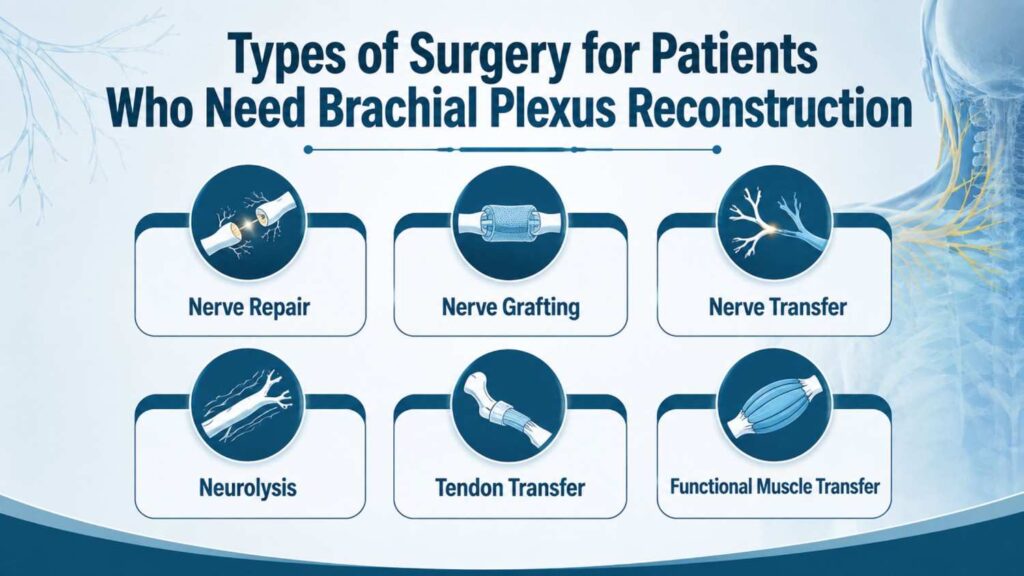
Depending on the remaining muscles, tendons, nerves, and joints, reconstructive options may include:
- Nerve transfer
- Tendon transfer
- Functional muscle transfer
- Other reconstructive procedures
- Procedures focused on pain management
The appropriate option depends on the individual injury and the remaining functional anatomy.
Who Needs Brachial Plexus Surgery for Functional Loss?
The ultimate purpose of brachial plexus reconstruction is not simply to repair an abnormal nerve on an imaging scan. The goal is to improve useful function.
Patients may experience difficulty with:
- Raising the arm
- Bending the elbow
- Straightening the elbow
- Rotating the forearm
- Opening or closing the hand
- Holding objects
- Dressing
- Eating
- Personal hygiene
- Driving
- Working
- Performing household activities
When these limitations significantly interfere with independence and the injury is unlikely to recover naturally, surgical evaluation may be appropriate.
Therefore, who needs brachial plexus surgery should be considered from a functional perspective as well as a neurological one.
What Happens Before Brachial Plexus Surgery?
Before deciding whether someone needs brachial plexus surgery, a detailed assessment is usually performed.
This may include:
- Reviewing how the injury occurred.
- Recording the patient’s symptoms.
- Testing muscle strength.
- Assessing sensation.
- Checking reflexes.
- Evaluating shoulder, elbow, wrist, and hand movement.
- Reviewing previous treatment.
- Performing electrodiagnostic testing when appropriate.
- Reviewing MRI or other imaging.
- Determining the likely potential for spontaneous recovery.
- Identifying the patient’s most important functional goals.
This process helps establish whether surgery is necessary and, if so, which reconstruction may provide the best opportunity for useful recovery.
What Are the Goals of Surgery?
The goals of brachial plexus surgery vary from one patient to another.
Possible objectives include:
- Restoring shoulder movement
- Improving elbow flexion
- Improving hand function
- Restoring useful grip
- Improving sensation
- Reducing disabling nerve pain
- Improving arm stability
- Increasing independence
- Supporting return to daily activities
It is important to understand that nerve reconstruction does not guarantee complete restoration of normal function. Outcomes depend on many factors, including injury severity, location, timing, patient factors, muscle condition, and rehabilitation.
Recovery for People Who Need Brachial Plexus Surgery
Patients who undergo nerve reconstruction should understand that recovery is usually gradual.
Nerve tissue regenerates slowly, so improvement may take months and sometimes longer depending on the injury and procedure.
Recovery may involve:
- Protection of the surgical area
- Sling or splint use when recommended
- Physiotherapy
- Occupational therapy
- Range-of-motion exercises
- Muscle activation exercises
- Sensory re-education
- Functional training
- Regular clinical assessments
The rehabilitation program is not simply an optional addition to surgery. It is an important part of helping the recovering nerve and muscle system develop useful function.
Questions to Ask if You Think You Need Brachial Plexus Surgery
If you or someone you know has sustained a brachial plexus injury, useful questions for a specialist may include:
- How severe is the nerve injury?
- Which nerves are affected?
- Is the nerve likely to recover naturally?
- Is there evidence of nerve rupture or avulsion?
- What do the MRI and EMG results show?
- How long should recovery be observed?
- Would nerve repair be possible?
- Would nerve grafting be appropriate?
- Could a nerve transfer restore useful movement?
- Is tendon or muscle transfer an option?
- What function should be prioritized?
- How long could rehabilitation take?
- What are the potential risks and limitations of surgery?
These questions can help patients understand why a particular treatment has been recommended.
Common Misconceptions About Who Needs Brachial Plexus Surgery
Myth 1: Every Brachial Plexus Injury Requires Surgery
This is incorrect. Some mild injuries recover without an operation, particularly when there is evidence of progressive neurological recovery.
Myth 2: Severe Weakness Will Always Recover on Its Own
Severe nerve damage, including rupture and avulsion, may require reconstruction when spontaneous recovery is unlikely.
Myth 3: Surgery Can Always Restore Normal Function
Brachial plexus surgery aims to improve useful function, but complete restoration cannot be guaranteed. The outcome depends on multiple factors.
Myth 4: Waiting Several Years Is Always Safe
Delaying assessment can reduce the available reconstructive options in some patients because prolonged denervation can lead to muscle atrophy.
Myth 5: An MRI Alone Determines Treatment
Treatment decisions require a combination of clinical examination, functional assessment, electrodiagnostic studies, imaging, injury history, and recovery pattern.
When Should You Seek an Evaluation?
Anyone who develops significant weakness, paralysis, numbness, or severe nerve pain following trauma should seek medical evaluation.
An assessment is particularly important when:
- The arm cannot be lifted normally.
- The elbow cannot bend.
- The hand has lost movement.
- Grip strength suddenly disappears.
- Sensation is significantly reduced.
- Severe burning pain develops.
- The arm remains weak after an accident.
- Muscle wasting becomes noticeable.
- There is no meaningful improvement over time.
Early evaluation does not necessarily mean surgery. Instead, it allows the injury to be characterized accurately and monitored appropriately.
Why a Specialist Assessment Matters
Brachial plexus injuries are complex because several nerves can be affected at different levels simultaneously.
A patient may have one pattern of weakness while another person with a seemingly similar accident may have an entirely different injury.
This is why determining who needs brachial plexus surgery requires more than looking at symptoms alone.
A specialized assessment can help identify:
- The exact location of nerve damage
- The severity of the injury
- Whether spontaneous recovery is occurring
- Whether reconstruction is appropriate
- Which surgical technique may be suitable
- Which functional goals should be prioritized
- What rehabilitation may be required
The most appropriate treatment is therefore individualized rather than based on a one-size-fits-all approach.
Conclusion
Understanding who needs brachial plexus surgery is important because not every brachial plexus injury requires an operation. Surgery may be considered when nerves are severely damaged, ruptured, or avulsed, when significant weakness or paralysis persists, or when there is little evidence of natural recovery. The treatment approach depends on factors such as the severity and location of the injury, EMG and imaging findings, time since injury, muscle condition, and the patient’s functional goals. Depending on the situation, options may include nerve repair, nerve grafting, nerve transfer, neurolysis, tendon transfer, or functional muscle transfer.
Early and appropriate evaluation can help determine whether observation, rehabilitation, or surgical reconstruction is the right approach. Since nerve recovery is gradual and prolonged loss of nerve supply can affect muscle function, patients with persistent weakness, numbness, loss of movement, or severe nerve pain should seek timely specialist assessment. Ultimately, who needs brachial plexus surgery can only be determined through a detailed individual evaluation designed to identify the most suitable treatment and maximize the potential for meaningful functional recovery. For additional information about brachial plexus surgery, you can refer to Johns Hopkins Medicine, which provides an overview of surgical treatment options and nerve reconstruction procedures.
Frequently Asked Questions
Can a brachial plexus injury heal without surgery?
Can brachial plexus surgery restore normal arm function?
Is brachial plexus surgery suitable for everyone?
Can physiotherapy replace brachial plexus surgery?
Does age affect the outcome of brachial plexus surgery?
Can brachial plexus surgery be performed after several years?
Is brachial plexus surgery performed under general anesthesia?
How long does recovery take after brachial plexus surgery?
Can brachial plexus surgery help with chronic nerve pain?
What specialist evaluates the need for brachial plexus surgery?

Dr. Pradeep Kumar
Plastic & Reconstructive Surgeon – Brachial Plexus & Nerve Surgery Specialist
Dr. Pradeep Kumar is an experienced plastic and reconstructive surgeon known for his expertise in brachial plexus and peripheral nerve surgery. With extensive microsurgical experience, he focuses on restoring movement and function for patients with complex nerve injuries.
Sushrutha Institute of Plastic Surgery, Elite Mission Hospital, Thrissur